Most marketers are stuck in the wrong zone. Not the zone of incompetence—that’s obvious and uncomfortable enough to force change. The real trap is subtler. You’re performing well, getting promoted, hitting targets. But something feels off. You’re operating at a high level without feeling fully alive in your work.
Gay Hendricks calls this the Zone of Excellence, and he argues it’s the most dangerous place for your career. In his book The Big Leap, Hendricks lays out a framework of four zones that explains why talented people plateau—and what it takes to break through.
For marketers, this framework is particularly relevant. Marketing roles are broad, fluid, and constantly evolving. It’s easy to drift into work you’re good at but don’t love, especially when the team needs someone to “just handle it.” Understanding your zone of genius helps you make deliberate choices about where to spend your time—and where to stop.
Table of contents
Open Table of contents
The Four Zones
Hendricks describes four levels at which we operate. Most people cycle between the first three without ever reaching the fourth.
Zone of Incompetence — Work you’re not good at and don’t enjoy. For a marketer, this might be detailed financial modelling or deep backend engineering. The fix is obvious: delegate or avoid entirely. Most people handle this zone naturally because the discomfort is immediate.
Zone of Competence — Work you can do adequately, but others can do just as well. Think basic admin, reporting tasks, or managing calendars. You can get it done, but there’s no particular reason it should be you.
Zone of Excellence — Work you’re genuinely skilled at, possibly even recognised for, but that doesn’t truly energise you. This is the danger zone. A content marketer who’s brilliant at SEO audits but finds them soul-crushing. A growth lead who’s excellent at managing paid campaigns but would rather be building strategy. You get positive feedback, so you keep doing it. Meanwhile, the work that would actually light you up sits untouched.
Zone of Genius — Work that draws on your unique abilities, energises you, and produces outsized results. Time disappears when you’re doing it. It feels less like effort and more like expression. For one marketer, that might be crafting brand narratives. For another, it’s designing experiments. For another, it’s facilitating cross-functional strategy sessions.
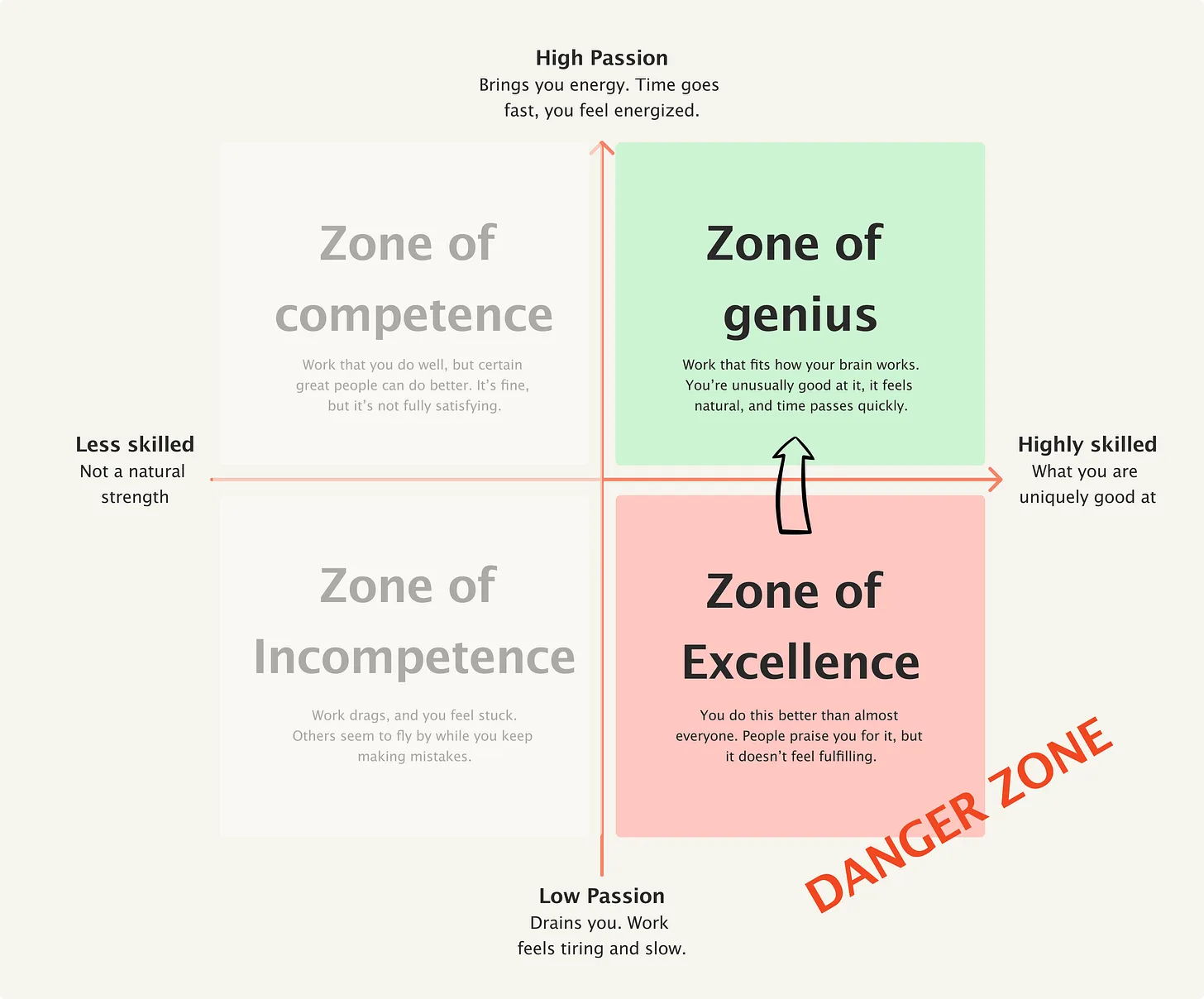
Why the Zone of Excellence Is the Real Trap
The Zone of Incompetence pushes you out. The Zone of Competence bores you out. But the Zone of Excellence? It seduces you into staying.
You’re rewarded for excellence. Managers praise it. Teams depend on it. Clients pay for it. So you keep delivering work that looks impressive from the outside but feels hollow on the inside. Years pass. You become the go-to person for something you never actually chose.
Hendricks calls this the Upper Limit Problem—the internal thermostat that keeps you from expanding into your full potential. When things are going well, you unconsciously sabotage or retreat to what’s comfortable. The Zone of Excellence is comfortable. The Zone of Genius requires vulnerability, risk, and the willingness to let go of what’s working well enough.
Rosie Hoggmascall captured this perfectly in her newsletter Growth Dives, describing how she identified her own zone of genius through a series of career pivots. Her core insight: the most dangerous zone for your career is the one you can sit in for ages. Unlike incompetence, which forces change, excellence offers no external trigger to move on.
Finding Your Marketing Zone of Genius
The zone of genius isn’t about what you’re good at. Plenty of marketers are good at plenty of things. It’s about the intersection of high skill and high energy—work where your ability and your enthusiasm compound each other.
Here are five questions to help you identify yours:
-
What work makes you lose track of time? Not the work you should enjoy based on your job title. The work you actually get absorbed in.
-
What do people specifically come to you for? Not your job description, but the informal requests. The things colleagues say “you’re the only person who can do this” about.
-
What would you do even if you weren’t paid? This reveals intrinsic motivation. If you’d still build marketing experiments on the weekend, that tells you something.
-
What feels effortless to you but difficult to others? Your genius often hides in plain sight because it comes so naturally you assume everyone can do it.
-
What energises you rather than drains you? Two marketers can both write well. One feels energised after writing a strategy doc. The other feels drained. Same skill, different zones.
Applying the Framework to Your Marketing Career
Once you’ve identified your zone of genius, the work begins. This isn’t about quitting your job tomorrow. It’s about making incremental shifts in how you spend your time.
Audit your current week. Track how you spend your time for five days. Categorise each block into the four zones. Most marketers discover they spend less than 20% of their time in their zone of genius. The goal is to push that toward 40-70%.
Delegate or automate your lower zones. If you’re spending hours on competence-level tasks, find ways to hand them off. AI tools have made this dramatically easier—tasks that once required a specialist can now be handled by a generalist with the right toolkit, or automated entirely.
Have the conversation with your manager. The zone of genius framework gives you language for a career conversation that goes beyond “I want more responsibility.” You can say: here’s where I produce my best work, here’s what drains me, here’s how restructuring my role benefits the team.
Resist the pull of excellence. This is the hardest part. You’ll be tempted to keep doing what you’re praised for. But every hour spent in your Zone of Excellence is an hour not spent in your Zone of Genius. The opportunity cost is real.
Zone of Genius for Marketing Teams
This framework isn’t just for individuals. Marketing leaders can use it to build stronger teams.
When you understand each team member’s zone of genius, you can:
- Assign work that plays to natural strengths rather than defaulting to whoever has capacity
- Reduce burnout by minimising time people spend in their zones of competence and excellence on work that drains them
- Improve output quality because people operating in their genius zone produce disproportionately better results
- Retain top talent by giving people work that energises them rather than work that merely uses their skills
The best marketing teams aren’t built by hiring for roles. They’re built by understanding what each person does at a level nobody else can match, then structuring the work around those unique contributions.
The Shift Worth Making
Marketing careers are long. You’ll spend decades doing this work. The difference between spending those decades in your Zone of Excellence versus your Zone of Genius is the difference between a successful career and a fulfilling one.
Hendricks’ framework doesn’t promise easy answers. Identifying your genius is the simple part. Restructuring your work to honour it—saying no to things you’re good at, tolerating the discomfort of growth, resisting the gravitational pull of comfortable excellence—that’s where the real leap happens.
Start this week. Audit your time. Ask yourself the hard questions. Talk to the people who know your work best. The zone of genius isn’t a destination you arrive at once. It’s a practice of continually choosing the work that only you can do.