
Table of contents
What are growth loops?
A growth loop is a self-reinforcing system where the output of one user action becomes the input for the next cycle. Unlike a traditional marketing funnel — which moves users linearly from awareness to conversion and then resets — a growth loop is circular: each completed cycle generates the conditions for the next one. This compounding structure means growth does not require constant reinvestment at the top of the funnel; instead, it accelerates as more users join the system.
Growth loops have become a cornerstone framework for modern growth teams, popularised by practitioners including Brian Balfour, Elena Verna, Casey Winters, and Andrew Chen. The underlying logic is straightforward: design your product or marketing so that each new user, piece of content, or unit of revenue creates the conditions for acquiring the next one.
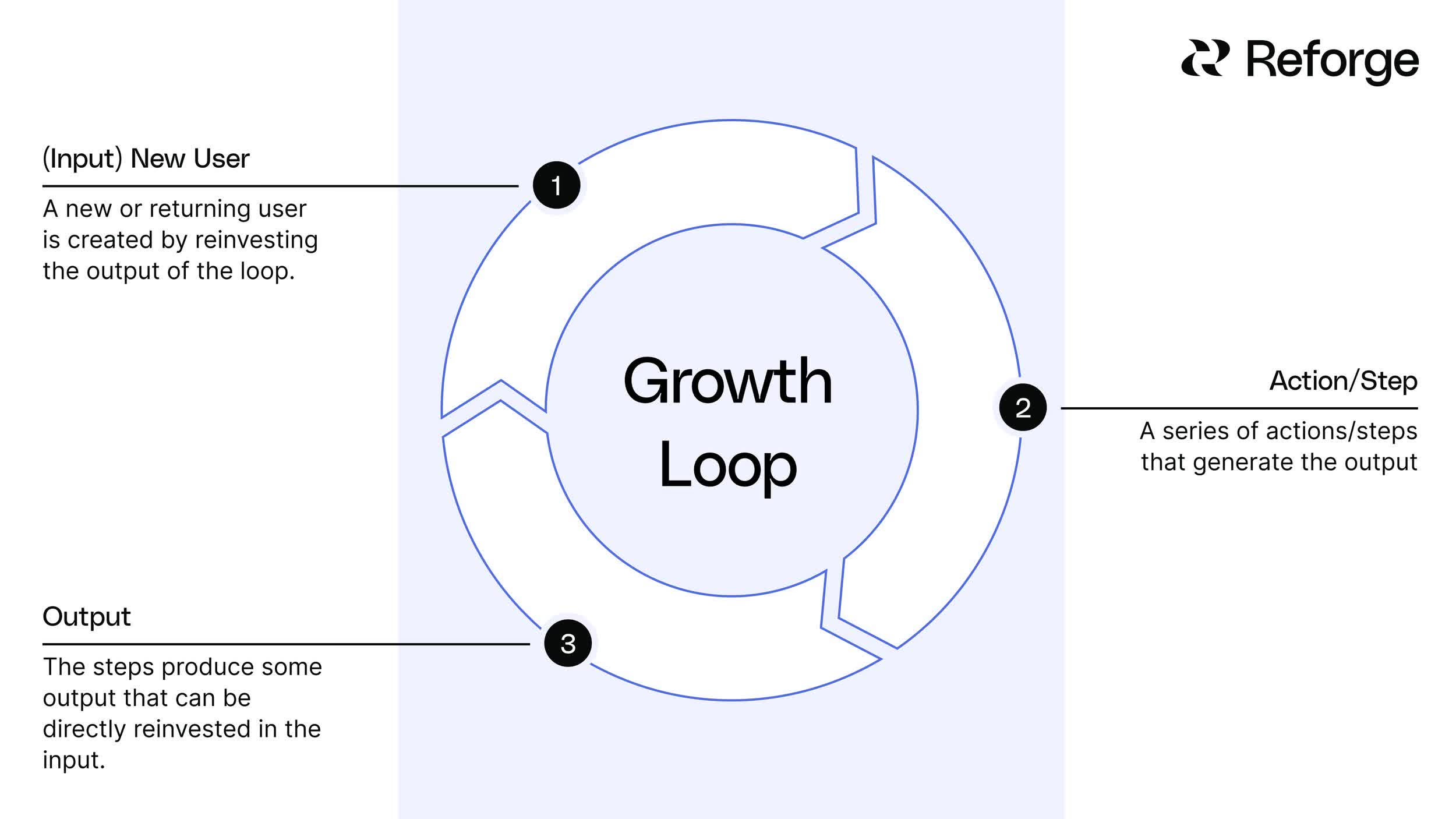
Loops are closed systems where the inputs through some process generates more of an output that can be reinvested in the input.
— Brian Balfour
Why loops, not funnels?
Funnels are linear and require constant investment at the top to maintain growth. Growth loops, by contrast, are self-reinforcing — each user action contributes directly to acquiring more users, creating sustainable, compounding growth.
Growth loops are also typically embedded directly into the product experience, making them harder for competitors to replicate. A paid acquisition tactic can be copied overnight; a well-designed loop that is native to your product takes years to reverse-engineer.
For a deeper look at how to choose the right channels to feed your loops, see our guide to traction channels.
Where growth loops thrive
Growth loops work particularly well in certain business models. Here are some examples:
| Business Type | Examples | Loop Mechanics |
|---|---|---|
| User-Generated Content (UGC) | Reddit, Quora | Users create content, attracting new users who then create more content. |
| Network Effects or Viral Loops | Dropbox, LinkedIn | Users invite others, expanding the network and driving further invitations. |
| Community-Led Growth | Slack, Discord | Community engagement attracts new members, who further enrich the community. |
| Sales Loops | Salesforce, HubSpot | Revenue from sales funds expansion of sales teams, driving further customer acquisition. |
Examples of successful growth loops
Here are some well-known examples of growth loops from high-growth companies:
- Dropbox: Users invite friends to earn extra storage, creating a viral referral loop.
- LinkedIn: Users invite professional contacts, expanding the network and attracting more users.
- Zoom: Meeting participants experience the product first-hand, prompting them to sign up and host their own meetings.
- Slack: Team collaboration drives adoption; as more team members join, the platform becomes more valuable, encouraging further adoption.
- HubSpot: Free tools and content attract users who then share these resources, driving further inbound traffic and sign-ups.
Main types of growth loops
Viral or referral growth loop
A viral loop uses existing users as the primary acquisition channel. Each user who experiences value is incentivised — or organically motivated — to share the product with others, who then join and repeat the cycle.
How it works:
- A new user signs up and reaches their activation moment.
- The product delivers clear value, prompting the user to invite others (via referral programme, share link, or word of mouth).
- Invited contacts sign up, experience value, and invite further contacts.
- Each cycle adds more users than the last.
Real-world example: Dropbox’s referral programme — users earned extra storage for every friend they invited. The loop was so efficient that referrals drove 3,900% growth for similar PLG businesses in its era.
Five referral mechanisms that work
The Dropbox story makes “referral loop” sound like one thing: an invite button and a reward. In practice the mechanism takes several forms, and the ones that work best are often the ones nobody files under referral. Marc Thomas, founder of Positive Human, who built doopoll and later ran growth at Podia, lists it as the bonus item in his checklist of what successful SaaS companies have in common:
Not every successful company has this but there’s usually something going on to drive referrals.
Marc Thomas, Founder, Positive Human
He names five that he has seen work in practice:
- Powered-by referrals. Your product is visible to non-users through normal use, so every embed or share carries the brand. In Marc’s words, “if you have a visible widget that gets shared or embedded, this is a great driver.” It worked for doopoll, Podia and Senja, and it is the origin story of Intercom’s chat widget. This is the referral loop that needs no incentive at all, only a product surface that non-users see.
- Additional seat invites. The most under-counted mechanism on this list. As Marc puts it, “if you have a way to add 10 extra people to your customers’ accounts, you’ve just acquired 10 additional users in theory and if your pricing reflects that, you’re onto a winner.” Balsamiq grew this way. Seat invites rarely appear in a referral programme spreadsheet, but every invited colleague is a new user acquired at zero marketing cost.
- An affiliate programme. The most involved option, and one that only pays off if the incentives are structured carefully. Marc’s warning is blunt: “don’t offer commission in perpetuity,” because it will stunt growth and eventually bite. He recommends Rewardful over the large affiliate networks, which he describes as hard to work with and full of scammers. We run our own affiliate programme on the same principle.
- An incentivised content programme. Users build reusable artefacts with your product (templates, workflows, datasets) and you co-promote them in exchange for commission, cash or credit. Airtable’s Universe library and the huge market of Notion templates are the reference examples. This is where the referral loop overlaps with the UGC loop below.
- An agency model. Marc includes this one as a caution rather than a recommendation. The theory is that agencies have many clients with a shared problem your product solves. Marc has sat on every side of that table, and his verdict is that “very few agencies have enough clout to sell software to their clients at a meaningful volume,” and the incentives are usually misaligned.
The practical lesson is that “referral” is not one line item. Each mechanism is a separate campaign with its own hypothesis, build cost and metric, and the right one depends on whether your product is public (powered-by), collaborative (seat invites), or bought on recommendation (affiliates). Run them as separate campaigns (plan, launch, analyse, repeat) rather than lumping them into a single referral programme.
User-generated content (UGC) growth loop
A UGC loop uses the content created by existing users to attract new users organically through search, social, or community discovery.
How it works:
- A user creates content on the platform (a review, a post, a template, a dataset).
- That content is indexed by search engines or shared across social platforms.
- New users discover the content, join the platform, and create more content.
- More content means more discovery surface, accelerating the loop.
Real-world example: G2 and Reddit. Every review or post created by an existing user becomes a search-discoverable asset that pulls in new users — who then add more content and continue the cycle.
Paid acquisition growth loop
A paid acquisition loop turns the revenue generated from paid marketing into the fuel for the next round of acquisition. Rather than treating paid spend as a cost centre, this model treats it as a self-funding flywheel.
How it works:
- Invest in paid channels (search, social, display) to acquire new users.
- Those users convert and generate revenue.
- A portion of that revenue is reinvested into paid acquisition, now at a larger scale.
- The loop compounds as long as the LTV:CAC ratio remains healthy.
Real-world example: HubSpot’s paid acquisition strategy. Free tools and paid ads drive sign-ups; a percentage of those users convert to paid plans, funding the next wave of acquisition at greater scale. Tracking the north star metric is essential to keeping this loop honest.
Sales growth loop
The sales growth loop uses revenue from closed deals to expand the sales team, which in turn closes more deals and generates more revenue to hire further.
How it works:
- The sales team acquires new enterprise customers.
- Revenue from those customers funds the hiring of additional sales reps.
- The expanded team acquires more customers, generating more revenue.
- Each hiring wave unlocks a new tranche of capacity.
Real-world example: Salesforce’s sales-driven growth strategy. Consistent revenue growth funded aggressive sales hiring, which compounded the pipeline and made Salesforce the dominant CRM platform.
Growth loops vs funnels
Traditional marketing funnels — including the RACE Framework and the AARRR pirate metrics model — guide customers through linear stages from awareness to conversion. Growth loops replace or augment the funnel model with a circular, compounding structure.
| Dimension | Growth Loop | Traditional Funnel |
|---|---|---|
| Shape | Circular — outputs feed the next cycle | Linear — users pass through once and exit |
| Growth pattern | Compounding — each cycle is larger than the last | Incremental — growth requires more top-of-funnel input |
| Team ownership | Cross-functional (product, marketing, sales) | Typically siloed by department |
| Cost over time | Decreasing CAC as the loop matures | Constant or rising CAC as competition increases |
| Compounding effect | Yes — each user can generate multiple future users | No — the funnel resets after each conversion |
| Best for | Scalable, sustainable growth | Short-term campaigns and measuring conversion stages |
Funnels remain useful for measuring effectiveness at each stage of the customer journey, especially in B2B environments with longer sales cycles. The highest-performing growth teams combine both: funnels to diagnose where users drop off, loops to engineer sustainable acquisition.
Why retention matters for growth loops
Retention significantly amplifies the effectiveness of growth loops. Even small improvements in retention can dramatically boost growth:
- Viral loops: Higher retention increases the number of active users who can make referrals.
- UGC loops: Better retention leads to more content creation, attracting new users.
- Paid acquisition loops: Improved retention accelerates revenue reinvestment into paid channels.
- Sales loops: Increased retention generates more revenue, enabling further investment in sales teams.
Our takeaways
Funnels remain useful for measuring marketing effectiveness, especially in B2B environments with longer sales cycles. However, we strongly recommend combining funnels with growth loops. Your primary marketing efforts should focus on initiatives that compound and deliver sustainable results over time.
About Growth Method
Growth loops are systems thinking applied to marketing: you are engineering something that compounds, not chasing one-off wins. That is the mindset Growth Method is built around. It is an agentic marketing platform that helps a small team, or even a solo marketer, generate campaign ideas from your real data, prioritise the ones most likely to compound, launch them, and prove what worked.
We are on-track to deliver a 43% increase in inbound leads this year. There is no doubt the adoption of Growth Method is the primary driver behind these results.
Laura Perrott, Colt Technology Services
The marketers who win treat growth like engineers: plan, launch, analyse, repeat. Get started to run that loop on your own campaigns.
Frequently asked questions
What is a growth loop?
A growth loop is a self-reinforcing system where the output of one user action becomes the input for the next cycle, creating compounding, sustainable growth without requiring constant reinvestment at the top of a funnel.
What are the types of growth loops?
The four main types are viral (referral) loops, user-generated content (UGC) loops, paid acquisition loops, and sales loops. Each type uses a different mechanism to turn existing users or revenue into new users.
What is the difference between a growth loop and a funnel?
A funnel is linear — it moves users from awareness to conversion once and requires constant top-of-funnel investment to sustain growth. A growth loop is circular — each completed cycle generates the inputs for the next cycle, so growth compounds over time rather than resetting.
What is an example of a growth loop?
Dropbox is a classic example. Users sign up, invite friends to earn extra storage, those friends sign up and invite more friends, and the cycle repeats — each loop adding new users without additional paid acquisition spend.
What kinds of referral mechanism work for SaaS?
Beyond the classic invite-and-reward programme, the referral mechanisms that reliably work for SaaS are powered-by referrals (a visible widget or embed that non-users see), additional seat invites (customers adding colleagues to their account), affiliate programmes with time-limited commission, and incentivised content programmes such as template libraries. Agency partnerships are usually a poor referral channel because the incentives are misaligned.
Further reading
- NoGood: Growth Loops
- Mambo.io: Growth Loops
- North Star Metric & Framework — how to define the north star metric that anchors your growth loop strategy
- Traction Channels — the 19 channels to consider when selecting the acquisition input for your loop