
Table of contents
- What is marketing operations?
- Why you need marketing operations?
- What are the benefits to marketing operations?
- What exactly does marketing operations do?
- Traditional vs AI-native marketing operations
- Why does your organisation need marketing operations?
- Is RevOps (Sales Ops + Marketing Ops) the future?
- Final thoughts
- Marketing operations resources
- About Growth Method
- Frequently asked questions
Marketing operations is what turns your growth marketing strategy from a plan into disciplined, day-to-day execution.
If there’s one word that sums up the role of marketing operations, it’s effectiveness of your marketing team. Let’s dive in.
What is marketing operations?
Marketing operations (aka MOps or MarkOps) is the function responsible for the systems, processes and data that let a marketing team plan, execute and measure its work reliably at scale.
Marketing operations is the function of overseeing an organization’s marketing program, campaign planning and annual strategic planning activities. Other responsibilities include technology and performance measurement and reporting and data analytics.
According to the 2022 State of the Marketing Ops Professional report, 80%+ of companies had a dedicated marketing operations individual or team as of 2022, up from 65% in 2021. The 2025 edition of the same research shows the function maturing further, with teams shrinking toward “teams of one” and stepping deeper into RevOps.
Why you need marketing operations?
Have you seen the MarketingLand graphic from Mark Ritson and Matt Dillon? We are huge fans!
Here’s why: It does an excellent job of laying out a successful marketing route, which most savvy marketers know begins with understanding your target audience.
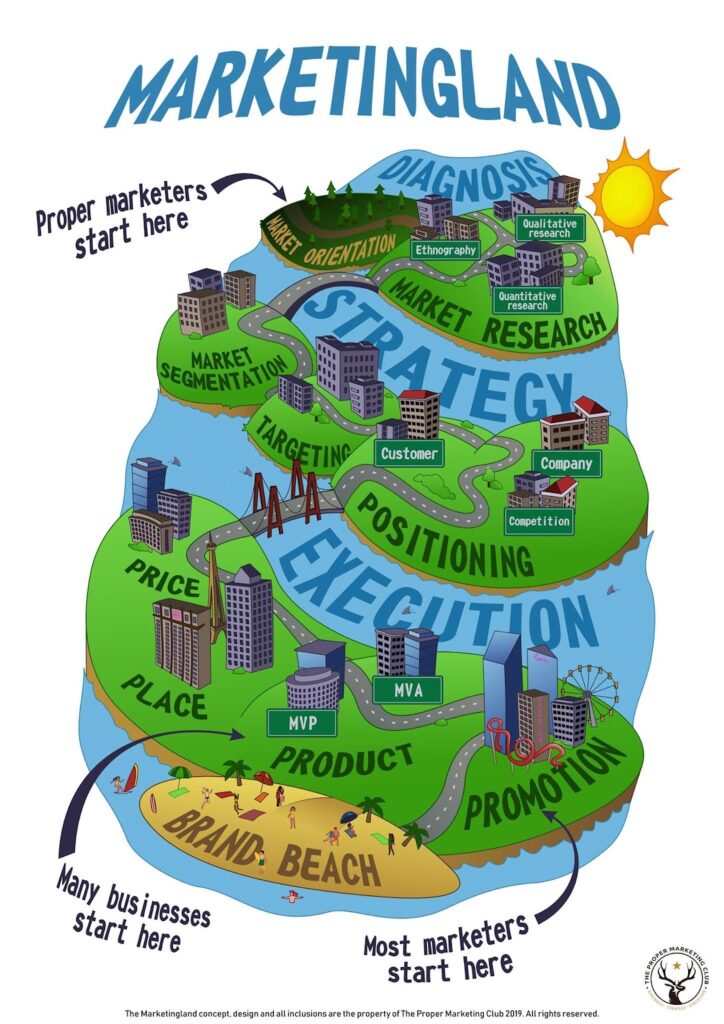
Marketing operations is the oil that makes everything in marketing land run smoothly — particularly within larger teams. If MarketingLand is about diagnosis, strategy and execution, marketing operations is about supporting these core activities for optimal performance.
Now, why is this support for marketing activities so important that 15% more companies incorporated it in 2022 compared to 2021?
For one, recent shifts in customer behavior, economic conditions, and board expectations have caused CMOs to go all in on the pursuit of operational excellence. They need more to be done with even fewer resources, hence, the need for near zero-waste performance.
Also, fast-changing events with global impact—like COVID-19 or the Russian invasion of Ukraine—have led to a shift from growth at all costs to sustainable and efficient growth. More than ever marketing is now about driving business outcomes, not vanity metrics.
If you want marketing to have a seat at the revenue table alongside CEO, CRO, CTO, etc., you need to have KPIs focused on pipeline and revenue. Marketing should own a percentage of the pipeline number.
What are the benefits to marketing operations?
We’ve hinted at a few earlier but there’s more:
-
Effective MarkOps create cost optimisation initiatives. This in turn increases the need for a marketing operations leader role to sustainably support the budget-efficient performance of your marketing department.
-
Identify and fix operational weaknesses in marketing and measure progress against your organisation’s overarching goals and strategies.
-
Upgrade your marketing processes from over reliance on spreadsheets to optimised and more productive MarTech solutions.
So, how exactly does MOps make this happen? Or is this all just fancy board table talk to please stakeholders?
What exactly does marketing operations do?
Traditionally, marketing ops has centred heavily around technology and marketing automation platforms in particular (think: Salesforce, Hubspot, and Marketo). It was focused on things such as lead management, database management, lead routing, lead scoring, pipeline forecasting, etc.
This is starting to change. The scope and role of MarkOps is widening significantly and is now a huge remit beyond just managing a technology platform. Much of that shift is what we’d call agentic work management: letting AI agents take on the operational load of running the tech stack, rather than a person doing it entirely by hand.
In fact, the scope of marketing operations individuals and teams varies hugely— lots of roles. We have outlined some of the more popular in-scope activities below (hat tip to the smart folks at Gartner).
Gartner defines marketing ops to include these functions:
-
Strategy and planning facilitation and effective communications
-
Campaign and lead management
-
Process optimization and governance
-
Data and analytics optimization and governance
-
Marketing technology selection, integration, optimization, governance and adoption
-
Technology & Systems: Responsible for the MarTech stack, maximising ROI on tech spend, supporting teams with technology strategy, leveraging automation for productivity.
-
Data & Analytics: Provide visibility and data for decision-making, build and maintain dashboards, data warehouses, and reports.
-
Processes & Project Management: Ensure clear processes, improve execution, enable continuous planning, support response to change, and manage lead tracking.
-
Alignment: Improve collaboration between marketing, sales, IT, finance, and other teams.
-
Communications: Manage internal and external communications, maintain stakeholder satisfaction, and reduce silos.
-
Goals & KPIs: Own and manage strategy and planning, align marketing goals with business objectives, often using a framework like OKRs to keep teams focused on outcomes rather than output.
-
Finance & Budgeting: Manage and optimise marketing spend, promote intelligent budget use, and demonstrate marketing ROI.
-
Vendor Management: Manage internal and external resources, including agencies and contractors.
To run all these varied functions and responsibilities without hiccups but with top-rated efficiency, a marketing project management tool is a critical component.
Traditional vs AI-native marketing operations
The scope of marketing operations hasn’t changed much, but the way it gets done is shifting fast. Here’s how a traditional MarkOps setup compares to an AI-native one:
| Traditional marketing operations | AI-native marketing operations | |
|---|---|---|
| Tooling | Marketing automation platform plus spreadsheets for tracking and reporting | Agents connected directly to the MarTech and analytics stack via MCP/API |
| Planning cycle | Quarterly or campaign-by-campaign, manually documented | Continuous, with campaigns proposed and prioritised from live performance data |
| KPI visibility | Built manually into dashboards after the fact | Tracked automatically against a baseline captured before each campaign launches |
| Execution speed | Bottlenecked by manual handoffs between strategy, build and reporting | Agents execute and report within the same workflow, cutting handoff time |
| Team structure | Dedicated MarkOps hire(s) managing process and tooling by hand | Generalist marketers supported by agents that handle the operational load |
This isn’t an argument that marketing operations disappears — the function described above is still essential. It’s that the work of framing, focusing, fixing and fitting your marketing operations increasingly runs through agents rather than manual process.
Why does your organisation need marketing operations?
Your organisation needs marketing operations to increase the effectiveness of your marketing team, helping to go past just optimising for efficiency and drive actual business impact.
You might think, “But after all I’ve read above, it seems to me that everyone in our marketing team is already handling the MarkOps function in one way or the other.” This isn’t going to work because marketing and growth teams are often overly focused on execution and lack in operational excellence to drive the marketing ops engine.
You need a dedicated marketing ops leader. That comes with improved flexibility and responsiveness. Plus, you get to aim for effectiveness not efficiency.
Note: We have talked about some of the challenges here before in terms of outputs over outcomes; the trade-off between efficiency and effectiveness.
Is RevOps (Sales Ops + Marketing Ops) the future?
The new reality is that sales and marketing are continuously and increasingly integrated. Marketing needs to know more about sales, sales needs to know more about marketing, and we all need to know more about our customers.
Jill Rowley
What Jill described above is the current reality of Revenue Operations, where marketing, sales, and customer service departments work together to hit goals around common KPIs. RevOps keeps these three departments together to ensure full accountability and seamless team up.
If you dig deeper into this idea, you can see this cannot be possible without marketing ops. In fact, it plays a strong role in enabling RevOps to track things end-to-end (from sales through marketing to customer success) and unveil performance across the entire funnel.
We’re talking about things like visitor-to-lead conversion all the way through to closed/won revenue.
Final thoughts
Given the current economic environment, what opportunities exist to increase the effectiveness and efficiency of your marketing operations?
Marketing operations leaders are becoming increasingly common. Gartner research says 49% of surveyed marketers have a marketing operations leader in at least one team.
Marketing operations resources
Here are some additional recommended reading and resources on marketing operations.
-
The Marketing Operations Handbook – Michael McKinnon (Book)
-
What is marketing operations and who are MOps pros? – Chris Elwell (Article)
-
Marketing Operations is a Strategic Function – Sally Witzky (Article)
-
2020 Marketing Operations Survey – Sally Witzky, Gartner (Research / Survey)
-
Why Marketing Ops Needs a Seat at the Strategy Table – Glenn Bottomly (Podcast)
About Growth Method
Growth Method is the agentic marketing platform for B2B teams: plan your strategy, ship campaigns, and learn what works, all in one place, for people and agents. Marketing operations is exactly the discipline our own product is built to strengthen — instead of manually stitching together spreadsheets, dashboards and status meetings, an agent works from your live campaign and analytics data to plan, launch and report on marketing work end to end.
Where a traditional marketing operations function centralises tooling and process by hand, Growth Method’s agents connect directly to your MarTech and analytics stack — Google Analytics, Google Ads, Google Search Console, PostHog, Amplitude, Mixpanel, Microsoft Clarity, Webflow, GitHub and Buffer — so campaign governance, performance measurement and reporting happen automatically rather than as a separate operations workload.
We are on-track to deliver a 43% increase in inbound leads this year. There is no doubt the adoption of Growth Method is the primary driver behind these results.
Laura Perrott, Colt Technology Services
Growth Method costs $150 per user per month, with your first month free. Get started today and let an agent take on the operational load behind your next campaign.
Frequently asked questions
What’s the difference between marketing strategy and marketing operations?
Marketing strategy sets the direction — target audience, positioning, and the goals a team is working towards. Marketing operations is the function that turns that strategy into repeatable execution: managing the technology, processes, and data that let campaigns actually ship and get measured.
What does a marketing operations team actually own?
A marketing operations team typically owns the MarTech stack and its administration, campaign and lead management, performance reporting and analytics, workflow governance, and vendor or agency management. The exact remit varies by company, but research shows most teams take on four to five of these functions rather than all of them at once.
How do you choose a marketing operations platform for a growing team?
Start from your team’s actual workflow: how campaigns move from idea to launch to analysis, and where reporting currently breaks down. Prioritise platforms that integrate with your existing MarTech and analytics stack, support the reporting your operations lead already needs, and can scale as the team and campaign volume grow.
Is RevOps the same as marketing operations?
Not quite. RevOps (Revenue Operations) is a broader function that combines marketing, sales, and customer success operations under shared goals and metrics. Marketing operations is one of the disciplines that feeds into RevOps, focused specifically on the marketing function’s own systems, processes and reporting.
How can marketing operations become more efficient?
The biggest efficiency gains come from fixing the basics: poor team communication, under-used MarTech, and execution that isn’t linked back to strategy. Beyond that, agentic tools that connect directly to your live campaign and analytics data can remove much of the manual reporting and status-chasing that slows marketing operations down.