
Table of contents
This article is correct as of August 2026. Growth Method has made every attempt to ensure the accuracy and reliability of the information provided.
What is HubSpot?
HubSpot is a market-leading customer relationship management (CRM) platform for scaling companies. The platform includes marketing, sales, service, operations, and website management products though is most heavily used by customer-facing teams such as marketing and sales.
Founded in 2006, HubSpot now has 306,000+ customers across more than 135 countries and competes with Salesforce Marketing Cloud, Adobe Marketo Engage, and Microsoft Dynamics 365.
What is ClickUp?
ClickUp is a project management platform for individuals and teams. The platform includes features and functionality including tasks, docs, chat, goals, and more, and is mostly used by operations and service teams once a sale has closed.
Founded in 2017, ClickUp now has 20 million+ users worldwide and competes with Asana, Monday, Jira, Basecamp, Trello, Teamwork, and others.
What is the HubSpot + ClickUp announcement?
There are a number of elements to the announcement which includes:
-
HubSpot Ventures have made an undisclosed investment in ClickUp
-
A new two-way integration between HubSpot and ClickUp in order to keep data in sync
-
New automations for both HubSpot and ClickUp users
-
Discounted pricing for customers already using ClickUp or HubSpot
The main goal here is to create a more customer-centric integration that allows client-facing teams (the HubSpot customer base) and operational teams (the ClickUp customer base) to work more closely together, specifically to increase the efficiency of hand-offs and collaboration between customer acquisition and customer enablement functions.
If you use HubSpot or ClickUp and struggle with the hand-off process between marketing and sales teams closing the deal, and operational teams providing early activity and feedback, this integration could be for you. If you’re also using Notion internally, check out our new article on Growth Method’s Notion integration to streamline your growth experiments and ideas. And if what you actually need is an AI agent reading and writing HubSpot records directly, rather than a workflow trigger into another app, see our guide to the HubSpot MCP server.
HubSpot vs ClickUp at a glance
| HubSpot | ClickUp | |
|---|---|---|
| Core purpose | CRM for customer-facing teams: marketing, sales, service | Work management platform for tasks, docs, chat, and goals |
| Best for | Marketing and sales teams managing the customer relationship | Operational and delivery teams running the work after a deal closes |
| Pricing | Multiple tiers from a free CRM through to an Enterprise Customer Platform | Free Forever plan, then paid tiers from $7 per user/month (billed yearly) |
| Native integration depth | Two-way sync: HubSpot triggers create and update ClickUp tasks | Two-way sync: ClickUp triggers create and update HubSpot records |
For a deeper feature-by-feature look at ClickUp against a marketing-only platform, see our ClickUp vs Growth Method comparison.
What about HubSpot projects?
Some of you will be aware that HubSpot already has its own project management product. HubSpot Projects was a productivity tool launched in 2016 but has never really taken off. It includes a number of pre-built project templates such as lead nurturing, email newsletter creation, keyword research, and more, though they are all extremely basic.
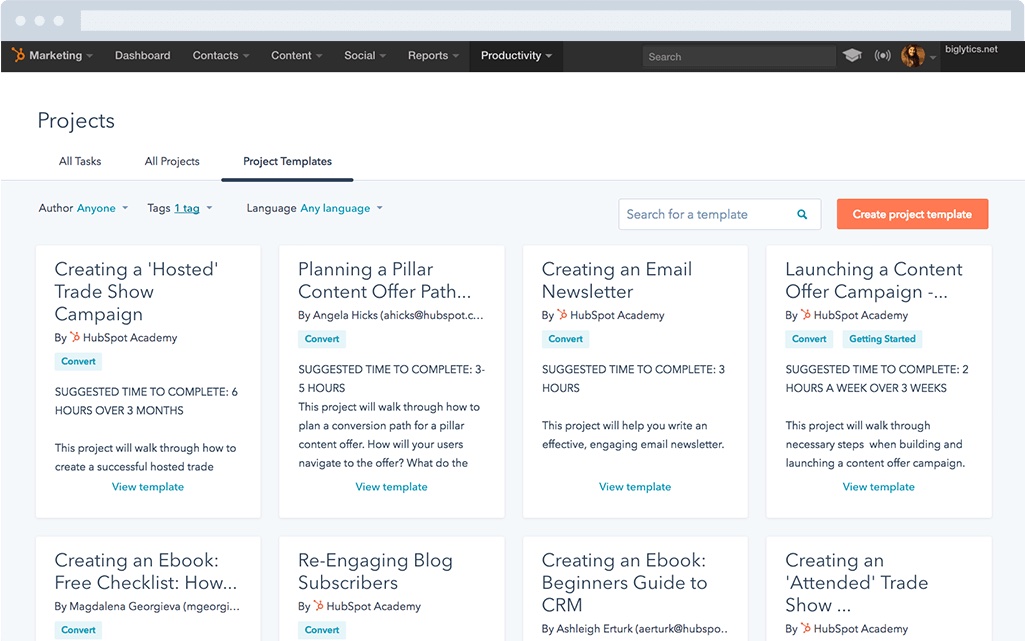
HubSpot projects can create tasks, and templates, and have some very light project management tools but struggle in more complex organizations, particularly marketing agencies. There is no way to have multiple clients in a single HubSpot portal using projects; it is effectively a separate project management tool for each customer.
More information on HubSpot Projects
What about Teamwork?
Up until now, Teamwork.com has been the only project management tool with a real native integration, with the ability to configure workflows such as “when X happens in HubSpot, do Y in Teamwork.”
The integration enables functionality such as:
-
Within HubSpot, you can create projects directly from deals and automatically add all of the contacts to your Teamwork site.
-
When a deal stage changes in HubSpot, create a project in Teamwork
-
When a deal stage changes in HubSpot, create a task in Teamwork
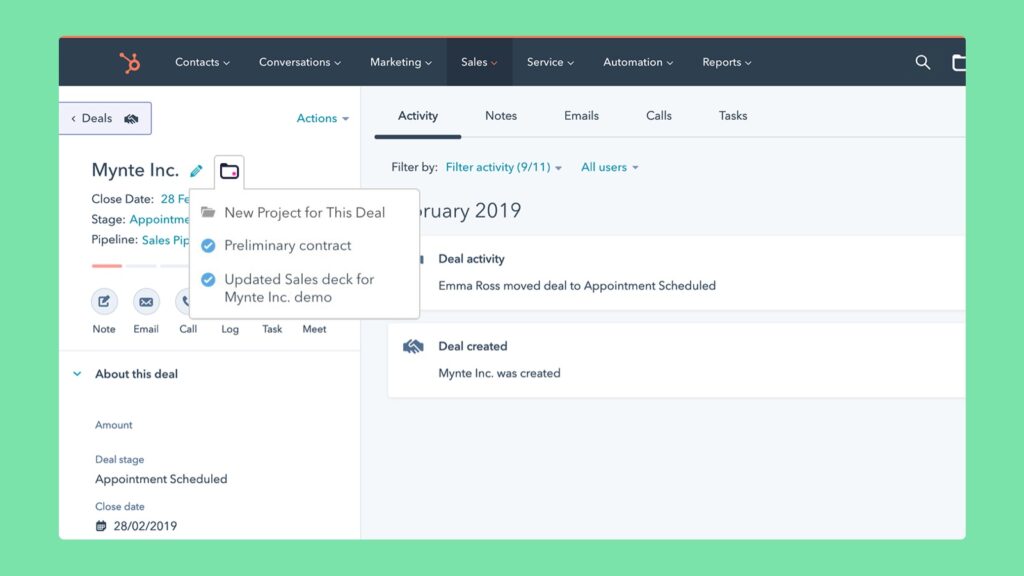
However, the integration is a personal integration and requires all Teamwork users to have the Teamwork Chrome Extension installed. The extension adds HubSpot icons at various points within the standard Teamwork interface and adds a Teamwork icon and menu to the HubSpot interface.
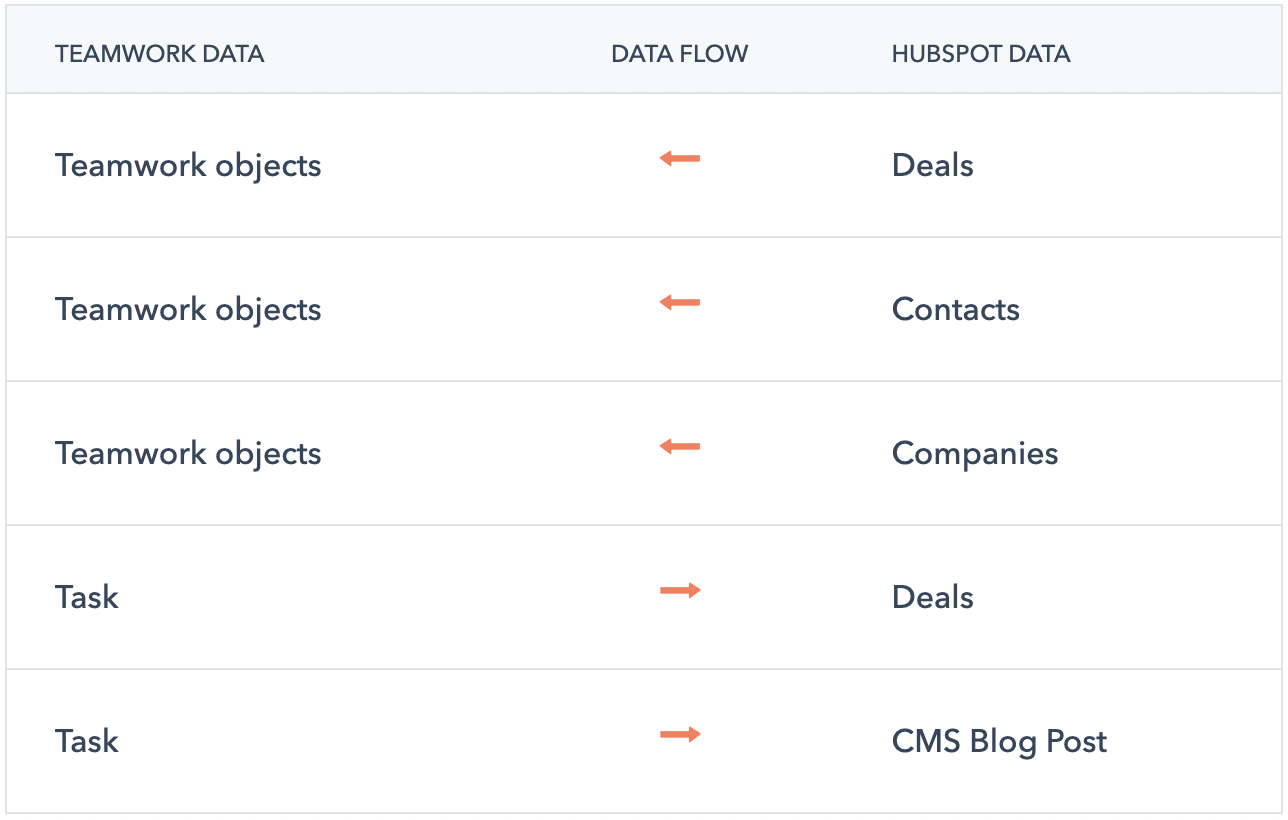
This is a relatively simplistic integration with no bi-directional capability or automations.
What can I do with the HubSpot & ClickUp integration today?
The HubSpot + ClickUp integration is a direct integration on both platforms, meaning ClickUp actions are available directly from within HubSpot’s native workflows tool, and similarly, HubSpot actions are available directly from within ClickUp automations.
Some examples of functionality that is now available:
-
Create ClickUp tasks from new HubSpot CRM contacts
-
When a HubSpot deal is moved to closed-won, create a folder and task in ClickUp which includes key properties from the HubSpot deal (such as customer name, company name, contact details, and deal value).
-
When a HubSpot deal is moved to closed-won, create a fully-templated onboarding project in ClickUp
-
When the project manager on a project in ClickUp changes, update the related deal in HubSpot so that customer-facing teams are kept in the loop on who the main point of contact is
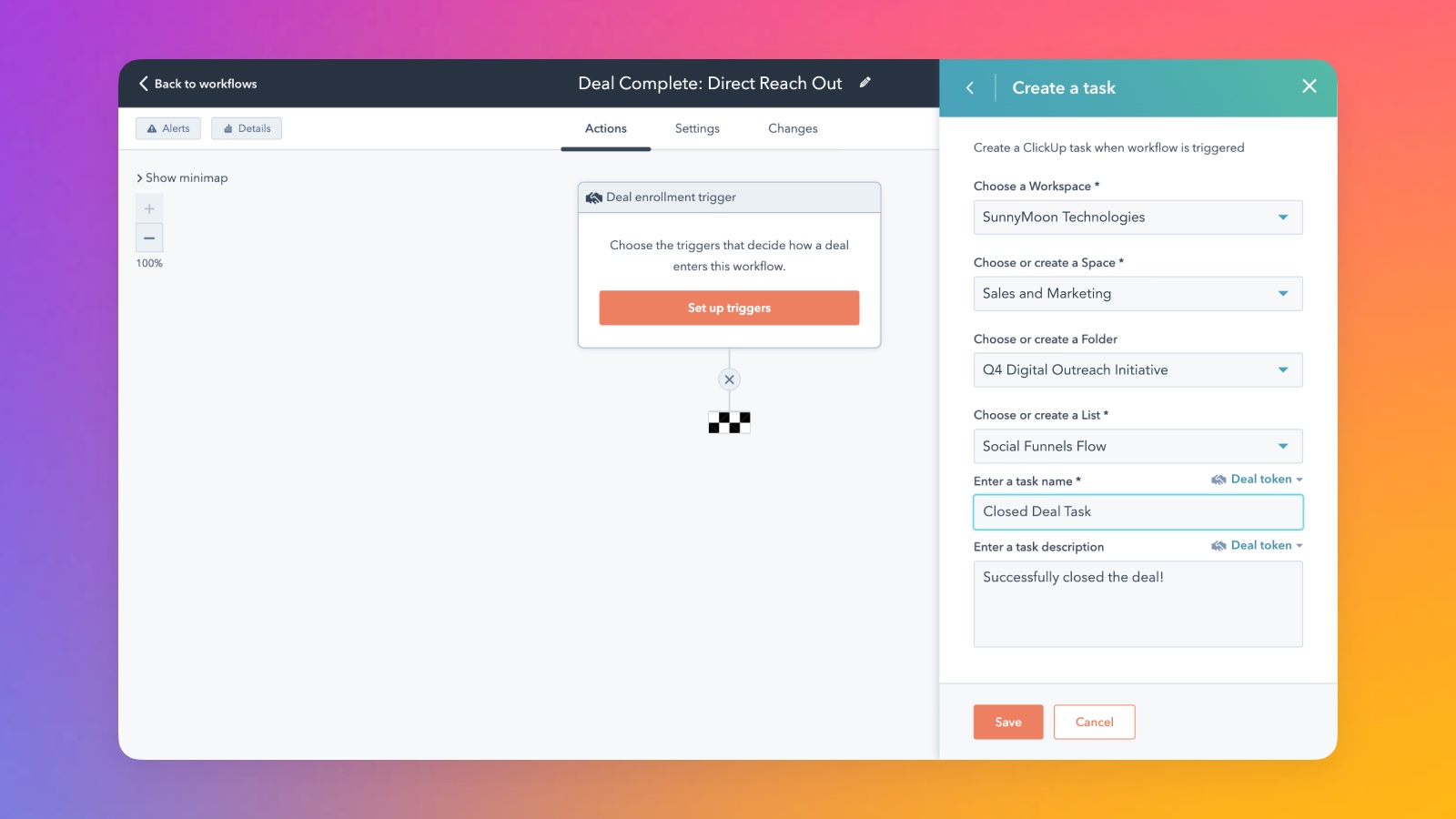
Here is an example of the standard HubSpot deal workflow when a ClickUp task creation panel is on the right-hand side. Deal tokens allow you to include any custom HubSpot data to pass to ClickUp, such as deal name, deal type, and amount.
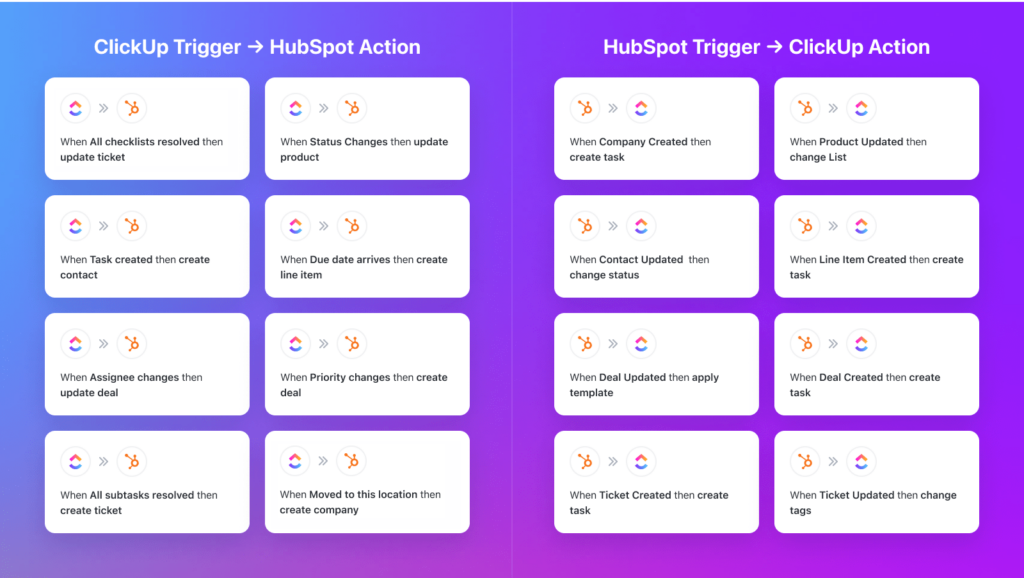
HubSpot to ClickUp triggers and actions
-
HubSpot triggers: New Deal, New Ticket, New Contact, New Line Item
-
ClickUp actions: Create task, Create subtask
ClickUp to HubSpot triggers and actions
-
ClickUp triggers: Status changes, Priority changes, Due date changes, Start date changes, Assignee changes, Task created, Existing task added to this location, Moved to this location, Task linked, Time tracked, All subtasks resolved, All checklists resolved, Task unblocked, Custom field changes, Due date arrives, Start date changes
-
HubSpot actions: Create ticket, Create contact, Create Deal, Create Company, Create Line_item, Create Product, Create task
Two-way sync
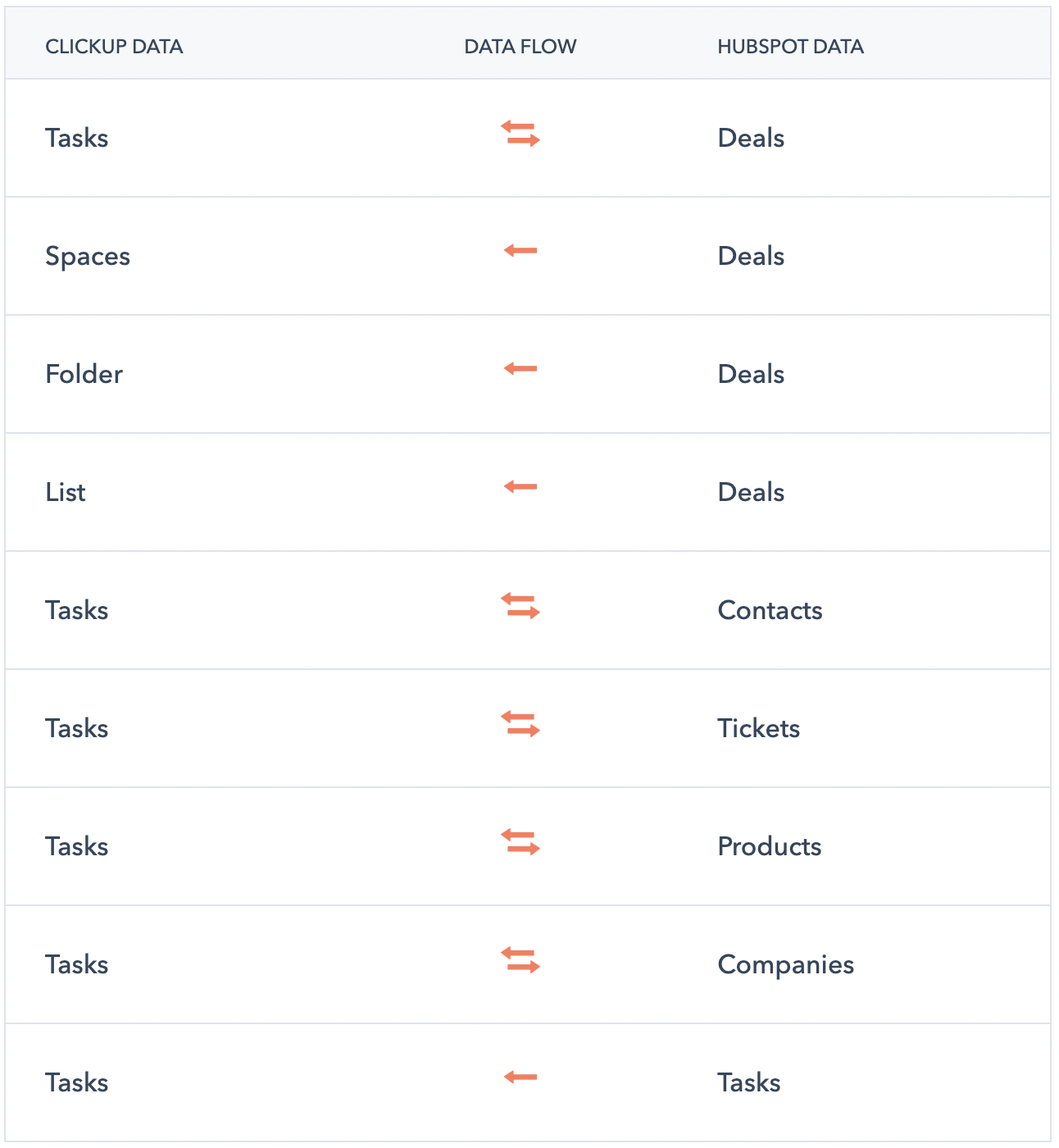
The image below shows the bi-directional synchronization of data, clearly this is only available for ClickUp tasks at the time of writing.
HubSpot & ClickUp Discounted Pricing
As part of the announcement, both ClickUp and HubSpot are providing discounted pricing for respective customers.
If you are a ClickUp customer, visit HubSpot’s ClickUp app listing to see current integration and pricing details.
If you are a HubSpot customer, go to this link to receive 20% off select ClickUp plans.
About Growth Method
The HubSpot + ClickUp integration solves a real problem: getting a closed-won deal to show up as a task in the right place, for the right team, without manual re-entry. But a clean hand-off between a CRM and a work management tool still leaves marketing teams without the thing they actually need day to day, a system built around campaigns, hypotheses, and results rather than tickets and tasks.
That’s the gap Growth Method is built to close. It’s the agentic marketing platform for B2B teams: plan a campaign’s hypothesis, launch it, and let AI agents pull the after-numbers straight from your connected analytics, whether that’s Google Analytics, Search Console, or PostHog, so you always know what worked and why. Instead of a task moving between two inboxes, you get a campaign lifecycle with a goal, a plan, and a result attached to it.
If your team is already stitching HubSpot and ClickUp together to manage marketing work, it’s worth asking whether the work itself is being measured, not just moved. Get started with Growth Method to see how campaigns, not just tasks, become the unit of work your team runs on.
Frequently asked questions
How do I set up the HubSpot ClickUp integration?
Connect the two platforms from ClickUp’s automations settings or HubSpot’s App Marketplace listing, then authorise both accounts. Once connected, you can build triggers such as creating a ClickUp task from a new HubSpot deal, or updating a HubSpot deal when a ClickUp task’s status changes, without any custom code.
How much does the HubSpot ClickUp integration cost?
The integration itself is included with both platforms. As part of the original partnership, HubSpot and ClickUp customers can each get 20% off select plans on the other platform, on top of whatever HubSpot or ClickUp plan you already pay for.
Do I still need Zapier if I connect HubSpot and ClickUp directly?
For the triggers and actions this integration covers natively, such as syncing deals, contacts, and tasks, no. Zapier is only worth adding back in for automations outside that native scope, or if you need to connect a third tool into the same workflow.
Final thoughts
The main advantages of the HubSpot and ClickUp integration include improved collaboration between customer-facing and operational teams.
If you’re rethinking how HubSpot’s broader marketing frameworks fit a test-and-learn approach, see our take on HubSpot’s Loop Marketing Playbook.
Got questions? Ping me on LinkedIn, or get started: first month free, no credit card required.