
Table of contents
Active marketing and passive marketing are two different approaches businesses use to attract and engage customers. Here we break down how to think about them, and how they relate to channel and acquisition strategy.
What is active marketing?
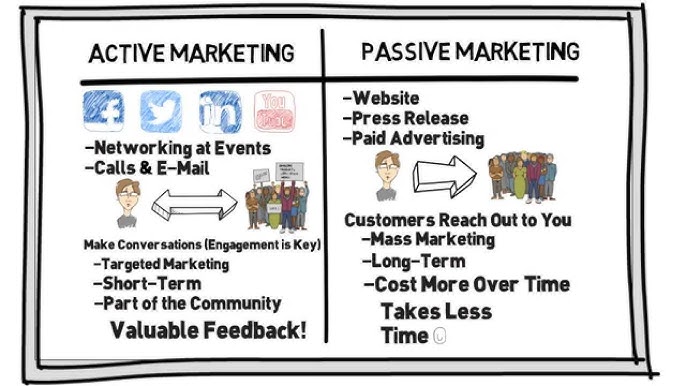
Active marketing involves proactive and direct efforts to reach potential customers. It requires a hands-on approach to engage with the target audience and promote products or services. Some key characteristics include:
-
Direct Outreach: This involves actively contacting potential customers through methods like cold calling, email campaigns, and direct mail.
-
Engagement: Active marketing often includes interactive strategies such as social media campaigns, live events, and webinars to directly engage with the audience.
-
Immediate Results: It aims to generate quick responses and immediate leads or sales. Examples include paid advertising (PPC), promotions, and sales blitzes.
-
High Effort: Requires significant time and resources to implement and manage.
What is passive marketing?
Passive marketing, on the other hand, focuses on creating a presence that attracts customers without direct outreach. It relies on creating an environment where customers can find the business on their own. Key characteristics include:
-
Indirect Outreach: Involves methods like content marketing, SEO (Search Engine Optimisation), and branding that make it easy for customers to discover the business.
-
Awareness Building: Passive marketing aims to build long-term awareness and credibility through blog posts, social media content, and informative videos.
-
Gradual Results: Results from passive marketing are often slower to materialise but can lead to more sustainable and long-term growth.
-
Lower Immediate Effort: Requires less direct interaction with potential customers and can be more cost-effective in the long run.
Differences between active and passive marketing
There are pros and cons to both approaches, though at Growth Method we tend to prefer passive acquisition channels and strategies as they tend to result in a calm, more sustainable culture for the marketing team, and a better experience for customers and prospects.
| Aspect | Active marketing | Passive marketing |
|---|---|---|
| Typical channels | Cold calling, email marketing, paid search ads | Content marketing, SEO, social media presence |
| Engagement | High engagement through direct interaction | Lower engagement, relies on audience finding content |
| Results | Immediate, quick responses | Gradual, long-term growth |
| Effort required | High effort and resources | Lower immediate effort, more sustainable long-term |
| Goal | Generate immediate leads or sales | Build long-term awareness and credibility |
| Cost | Often higher due to direct marketing costs | Generally lower, focused on organic growth |
| Measurement | Easier to measure short-term results | Harder to measure, focuses on long-term metrics |
| Customer interaction | Direct interaction with potential customers | Indirect interaction, customers engage at their own pace |
| Content strategy | Promotional, sales-oriented | Informative, value-driven content |
| Timeframe | Short-term focus | Long-term focus |
Some of our favourite passive strategies include SEO, email automations and product-led growth.
Key takeaways
When developing your marketing strategy, it’s essential to consider both active and passive marketing approaches to create a balanced, comprehensive plan that addresses both short-term goals and long-term growth. Use a channel portfolio strategy to decide how much weight each channel should carry, and look across the wider set of traction channels available to you before committing budget.
For most teams we suggest a 70/30 split to balance passive and active marketing strategies and channels, with 70% of time spent on passive marketing and 30% on active.
About Growth Method
Old playbooks treated “active vs passive” as a one-off strategy decision, set in a planning doc and rarely revisited. In an agentic marketing team, it’s a live allocation you test and adjust: Growth Method helps you plan the split, launch campaigns across both active and passive channels, and see which mix is actually moving your goal, rather than guessing from a slide written months ago. It’s built for teams who want to treat channel mix as an ongoing experiment, for people and agents alike.
If you want help shaping your own active/passive channel mix, get started to try it with your own campaigns.
Frequently asked questions
What is the main difference between active and passive marketing?
Active marketing means directly reaching out to prospects (cold calling, paid ads, email campaigns) for fast results. Passive marketing builds a discoverable presence (SEO, content, branding) so customers find you over time, with slower but more sustainable results.
Is passive marketing better than active marketing?
Neither is inherently better, they solve different problems. Passive marketing tends to produce a calmer, more sustainable growth culture and lower long-term cost, which is why we lean toward it, but most teams still need some active marketing for immediate pipeline.
What is a good active to passive marketing ratio?
We suggest a 70/30 split for most teams, with 70% of marketing time and budget spent on passive channels like SEO, content and product-led growth, and 30% on active channels like paid ads and outbound.
Can a small team run both active and passive marketing at once?
Yes. Most teams start with a small amount of active marketing to generate early traction, then shift investment toward passive channels as they compound, tracking the mix with a channel portfolio strategy over time.