
Table of contents
- Definition of multi-touch attribution
- An example of multi-touch attribution
- How does multi-touch attribution work?
- Expert opinions and perspectives
- Types of multi-touch attribution model
- The limits of multi-touch attribution
- How MTA compares to MMM and incrementality
- Questions to ask yourself
- Other articles you might like
- Additional reading
- About Growth Method
- Frequently asked questions
Multi-touch attribution is the honest upgrade over single-touch models like first-click and last-click. Instead of crowning one interaction, it spreads credit across the whole journey, which for mapping complex B2B paths is hard to beat. The catch, and it is a big one, is that even the best multi-touch model still only shows you correlation, not causation, and privacy changes have been steadily eroding the tracking it depends on. Treat it as the best map of the journey you can get, not proof of what caused the sale. For how it compares with every other model, see our marketing attribution models.
Definition of multi-touch attribution
Multi-touch attribution is a method used by marketers to understand and credit which marketing strategies are driving customer actions. It’s like a map that shows the journey a customer takes from the first time they hear about a product or service, through all the different touchpoints they interact with, until they finally make a purchase. This method helps marketers to identify which marketing channels or campaigns are most effective in influencing customer decisions.
In a simpler term, imagine you’re playing a football match. Multi-touch attribution is like a detailed report that shows who passed the ball, who assisted, and who scored the goal. It doesn’t just credit the person who scored, but recognises everyone who contributed to the goal. This way, marketers can see the full picture of their marketing efforts and make more informed decisions on where to invest their resources.
An example of multi-touch attribution
Here is an example of how it works:
Growth Method, a SaaS company, launches a new project management tool. They use various marketing channels to promote their product.
-
John, a project manager, first hears about the tool on LinkedIn where he sees a sponsored post from Growth Method. He clicks on the post but doesn’t make a purchase.
-
A week later, John receives an email from Growth Method, as he had previously signed up for their newsletter. The email contains information about the new tool. He clicks on the link in the email, browses the website, but still doesn’t make a purchase.
-
The next day, John sees a Google Ad for the same tool while searching for project management solutions. He clicks on the ad, revisits the website, and this time he signs up for a free trial.
-
After using the free trial for a week, John receives a follow-up email from Growth Method offering a discount if he purchases the full version of the tool. He clicks on the link in the email, goes to the website, and makes a purchase.
In this scenario, each touchpoint (LinkedIn post, email newsletter, Google Ad, follow-up email) contributed to John’s final decision to purchase the tool. This is an example of multi-touch attribution, where each marketing channel gets credit for the final conversion.
How does multi-touch attribution work?
Multi-touch attribution works by tracking and assigning value to all the touchpoints a consumer interacts with on their journey to a purchase. This method allows marketers to understand which marketing channels and campaigns are most effective in driving conversions. It involves tracking the customer’s journey from the first point of contact, such as an online ad or email, through various interactions like website visits, social media engagement, and finally to the point of purchase. Each touchpoint is then assigned a certain value or credit based on its contribution to the final conversion. This comprehensive view helps marketers optimize their strategies and allocate their budget more effectively.
Expert opinions and perspectives
Here are how some of the world’s best marketing and growth professionals, and companies, think about multi-touch attribution.
-
The problem multi-touch attribution exists to solve predates digital marketing: “Half the money I spend on advertising is wasted; the trouble is I don’t know which half,” a line long attributed to retail pioneer John Wanamaker. As Twilio’s guide to multi-touch attribution puts it, doing MTA well is “how you stop guessing which half of your advertising budget is wasted and start making decisions based on how customers behave.” - Twilio, “Multi-touch attribution: what it is & how to do it right”
-
“Attribution surfaces which interactions a person or group of people took along their journey toward a desired outcome or ‘conversion’ point.” - HubSpot’s product team

Types of multi-touch attribution model
“Multi-touch” is an umbrella, not a single method. The credit can be split by a fixed rule or by an algorithm:
| Model | How credit is assigned | Best for | Watch out for |
|---|---|---|---|
| Linear | Equal credit to every touchpoint in the journey | A simple, evenly-weighted view of a known multi-channel journey | Treats a first blog read and a final demo click as equally important, which they rarely are |
| Time-decay | More credit to the touches closest to conversion | Sales cycles where recent activity is the strongest signal of intent | Can undervalue the early content and brand touches that created the opportunity |
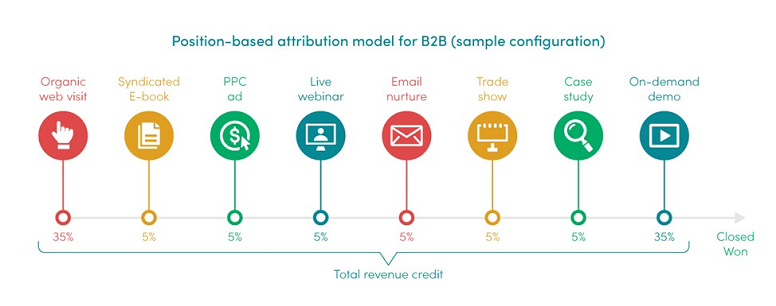
| Position-based (U-shaped) | Heavier credit on the first and last touch, less on everything between | Showing how a lead was found and how it converted | The middle of the journey, often where trust is built, gets squeezed out |
| W-shaped | Weights the first touch, the lead-creation touch, and the final touch | B2B journeys with a clear lead-creation milestone | Needs a well-defined “lead created” event, harder to set up than the others |
| Data-driven | An algorithm assigns credit from your own conversion data, often via Markov chains or Shapley values | Teams with enough conversion volume to train a model reliably | A black box: harder to explain to stakeholders, and only as good as the data feeding it |
The limits of multi-touch attribution
MTA is a genuine step up from last-click, but it is worth being honest about where it breaks down, because the gaps have widened in recent years:
- Privacy and tracking. GDPR, CCPA, third-party cookie deprecation, and iOS changes have fragmented the journey data MTA depends on. Stitching one person’s touches together across devices and platforms is harder every year.
- Walled gardens. Platforms like Google, Meta, and LinkedIn don’t share user-level data freely, so large parts of the journey stay invisible.
- Correlation, not causation. This is the big one. MTA shows you which touches appeared before a conversion. It cannot tell you which ones actually caused it, or what would have happened with no ads at all.
- Offline blind spots. Events, TV, word of mouth, and dark social rarely show up in the click data.
How MTA compares to MMM and incrementality
Because of those limits, the strongest measurement setups don’t rely on MTA alone. They triangulate it with two other approaches:
- Marketing mix modelling (MMM) works top-down on aggregate data, so it survives a cookieless world and captures offline channels MTA misses.
- Incrementality testing uses holdouts to measure what a channel actually caused, the causal question MTA can’t answer.
Used together, MTA maps the journey, incrementality checks whether each channel earns its keep, and MMM blends it all at the macro level. As Lifesight’s guide on the topic argues, causal approaches identify “the true impact of marketing activities by isolating the incremental revenue they generate”, where MTA on its own only tracks associations.
Questions to ask yourself
As a modern growth marketing or agile marketing professional, ask yourself the following questions with regard to multi-touch attribution:
-
Am I effectively tracking all customer touchpoints across various channels?
-
Do I have a clear understanding of the customer journey and how each touchpoint contributes to conversions?
-
Am I using the right multi-touch attribution model that best suits my business needs and marketing goals?
-
Am I regularly reviewing and adjusting my multi-touch attribution strategy based on data and insights?
-
Am I effectively using the insights from multi-touch attribution to optimise my marketing budget and improve ROI?
Other articles you might like
Here are some related articles and further reading you may find helpful.
Additional reading
Here are some related articles and further reading around multi-touch attribution that you may find helpful.
-
“Multi-touch attribution: What it is and why it’s important” - Smart Insights
-
“The Ultimate Guide to Multi-Touch Attribution” - Marketing Evolution
-
“The Comprehensive Guide to Multi-Touch Attribution Models” - Bizible
-
“The Definitive Guide to Attribution and Mix Modelling” - Neil Patel
About Growth Method
Picking a better attribution model is only useful if it changes what you do next. Growth Method is the agentic marketing platform for B2B teams: plan your strategy, launch campaigns, and let AI agents measure results against your real GA4, PostHog and Search Console data, closing the loop between a hypothesis like “our mid-funnel touches are under-credited” and the evidence that proves or disproves it.
Get started to turn your next attribution question into a tracked campaign, not a guess.
Frequently asked questions
What is multi-touch attribution?
Multi-touch attribution is a method for crediting the marketing touchpoints that influenced a customer’s journey, rather than giving all the credit to a single interaction. It spreads credit across the channels and content a buyer engaged with before converting, giving a fuller picture of what actually drove the outcome than first-click or last-click models allow.
What are the main types of multi-touch attribution model?
The main multi-touch models are linear (equal credit to every touch), time-decay (more credit closer to conversion), position-based or U-shaped (heavier credit on the first and last touch), W-shaped (adds a lead-creation touch to the U-shape), and data-driven (an algorithm assigns credit from your own conversion data, often via Markov chains or Shapley values).
What are the limits of multi-touch attribution?
Multi-touch attribution shows correlation, not causation: it cannot prove what actually caused a sale, only which touches appeared along the way. It also depends on tracking data that privacy rules and walled gardens increasingly fragment, and it misses offline influence like events, TV or word of mouth. Pairing it with marketing mix modelling and incrementality testing gives a more complete, causal picture.