
Table of contents
What is Parkinson’s Law?
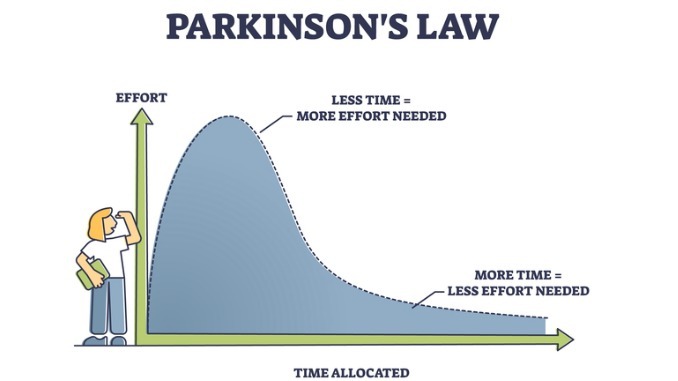
Parkinson’s Law states that work expands to fill the time available for its completion. Coined by British historian and author Cyril Northcote Parkinson in a 1955 essay for The Economist, the principle explains why tasks often take longer than necessary — not because they are genuinely complex, but because the time available encourages padding, perfectionism, and procrastination.
In short: give a task two hours and it takes two hours. Give it two weeks and it takes two weeks.
Parkinson’s Law Meaning and Origin
The meaning of Parkinson’s Law is deceptively simple: work is elastic. It stretches or compresses to fit whatever time container you give it. The original observation was made in the context of bureaucracy — Parkinson noted that British civil servants multiplied in number regardless of how much (or little) actual work existed. But the principle applies just as powerfully to individual tasks, marketing projects, and team planning.
The original quote from The Economist (19 November 1955):
“Work expands so as to fill the time available for its completion.”
Today, Parkinson’s Law is widely cited in productivity, project management, and agile methodology circles as a core reason why deadlines — and tight ones — matter.
Definition of Parkinson’s Law
A working definition for marketers and growth professionals:
Parkinson’s Law is the observation that the time taken to complete a task will expand to match the time allocated to it, regardless of the task’s actual complexity. The corollary is that artificially tightening deadlines — without sacrificing quality — often produces faster, better-focused work.
An Example of Parkinson’s Law
Here is an example of how it works in practice:
Growth Method, a SaaS company, launches a project to build a new marketing automation tool. Initially estimated at six months with five developers, the project gains internal momentum. Scope creeps, the team grows to 15, and the timeline extends to 12 months.
As the team expands, meetings multiply, communication overhead grows, and developers spend more time in status calls than writing code. Despite more resources and more time, the project still isn’t finished after 12 months. Parkinson’s Law is in full effect: the work expanded to fill the available time, and the larger container created its own inefficiencies.
How Does Parkinson’s Law Work?
Parkinson’s Law operates through several interconnected mechanisms:
- Time anchoring — people unconsciously pace their work to match the deadline, not the actual complexity.
- Scope creep — extra time creates space for new ideas, revisions, and additions that weren’t in the original brief.
- Perfectionism — more time encourages over-polishing rather than shipping.
- Procrastination — a distant deadline removes urgency, so work is delayed until the final stretch.
For marketers, this means that a campaign given four weeks of runway will often fill four weeks — even if the core work could be done in ten days.
How to Beat Parkinson’s Law at Work
The most effective counter-strategies are:
- Set tighter deadlines deliberately. Use timeboxing — allocate a fixed window for a task and stop when time is up, not when you feel it’s perfect.
- Break projects into smaller tasks with short deadlines. A two-week sprint with daily check-ins produces different behaviour than a single two-week deadline.
- Separate “good enough to ship” from “perfect”. Define what done actually looks like before you start.
- Limit work in progress. Multitasking inflates perceived time available and invites Parkinson’s Law across multiple workstreams simultaneously.
- Use retrospectives. At the end of every campaign or sprint, ask: how long did this actually take vs. how long did we estimate? The pattern reveals where Parkinson’s Law is biting you.
Expert Opinions and Perspectives
Here is how some of the world’s best marketing and growth professionals think about Parkinson’s Law.
-
“Parkinson’s Law — work expands to fill the time available for its completion — is as applicable to marketing as it is to any other discipline. The key is to set realistic deadlines and stick to them.” — Philip Kotler, American marketing author, consultant, and professor.
-
“In marketing, Parkinson’s Law reminds us that the more time we have to complete a task, the more complex and convoluted our solutions become. Focus on simplicity and clarity to achieve better results in less time.” — Seth Godin, American author, entrepreneur, and marketer.
-
“Parkinson’s Law teaches us that constraints can be a marketer’s best friend. By limiting the time and resources available for a project, we force ourselves to think creatively and prioritize the most impactful strategies.” — Ann Handley, American author and marketing expert.
Questions to Ask Yourself
As a modern growth marketing or agile marketing professional, ask yourself the following questions with regard to Parkinson’s Law:
- How can I set realistic deadlines for my marketing tasks to prevent unnecessary time consumption due to Parkinson’s Law?
- What strategies can I implement to prioritise tasks and allocate resources efficiently, avoiding the expansion of work to fill the available time?
- How can I break down larger projects into smaller tasks with shorter deadlines to maintain focus and prevent work from expanding unnecessarily?
- What tools or techniques can I use to track my progress and ensure that I am staying on schedule, avoiding the pitfalls of Parkinson’s Law?
- How can I encourage my team to work efficiently and effectively, fostering a culture that values productivity and resists the tendency for work to expand to fill the time available?
Additional Reading
Here are some related articles and further reading around Parkinson’s Law that you may find helpful.
See how this topic is trending on Google Trends here: https://trends.google.com/trends/explore?date=all&q=parkinson%27s%20law
More questions? Connect with me on LinkedIn, or get started: first month free, no credit card required.