
Table of contents
Thinking about using Jira for your marketing team? We write the most in-depth reviews of marketing project management software today.
To date the Growth Method team has reviewing marketing and growth marketing project management tools including Panobi, Planview, Effective Experiments, Airtable, Upgrow, TrueNorth, ClickUp & Asana.
If you’re considering alternatives, check out our latest guide: Discover the Best Jira Alternative That Will Transform Your Project Management.
What is Jira?
Jira (later called Jira Software) started out as a project management tool for software development teams.
On the 21st April 2021 Jira Management Suite was launched as an extension to the core Jira software product. The release introduced a new, user-friendly interface and functionality tailored specifically for business teams, including HR, finance … and marketing.
On the 30th April 2024 Jira software and Jira Management Suite were combined into a new product called … wait for it … Jira.
Why Use Jira for Marketing Teams?
Jira helps marketing teams manage campaigns efficiently by breaking projects into tasks, assigning responsibilities, and tracking progress. With custom workflows and templates designed for marketing, teams can streamline processes like content approvals and campaign launches. Collaboration is seamless, as Jira centralises updates and communication, keeping everyone aligned.
Using Jira for marketing projects
Using Jira for marketing projects includes many of the features you would expect to simplify marketing project management and enhance cross-team collaboration including:
1 Task planning and prioritisation
Jira for marketing teams includes the ability to organise tasks with Board (Kanban), List, Calendar and Timeline (Gantt chart) views of work:
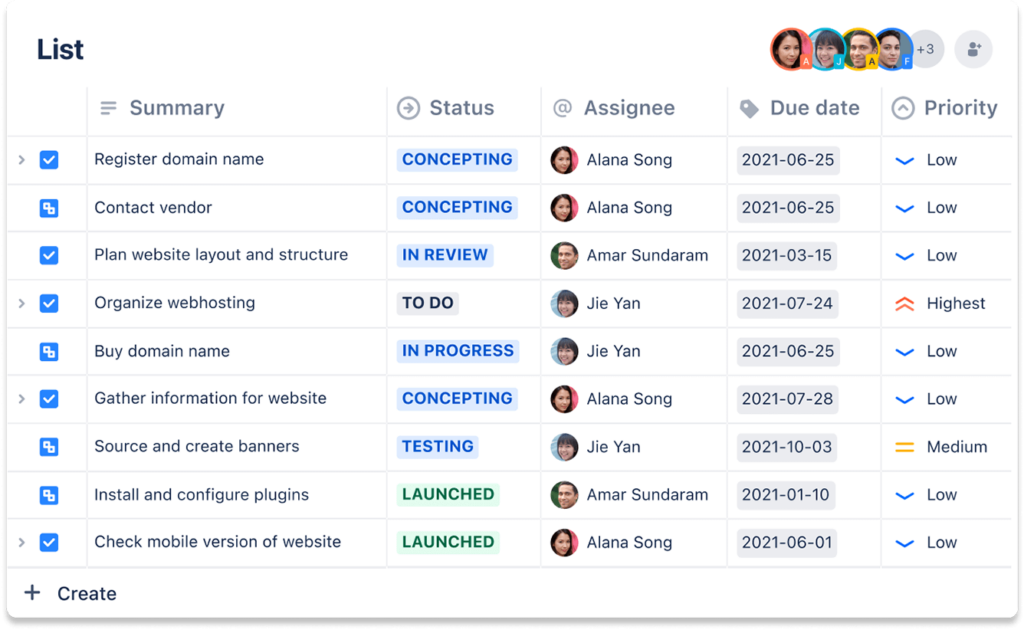
The typical workflow for a marketing team in Jira would be to:
-
Add tasks - using either the list, board or calendar view
-
Add start and due dates
-
Assign team members
-
Prioritise work (default priorities are Critical, High, Medium, Low)
-
Leverage automation where possible
2 Marketing Reporting
Marketing reports in JIRA are tools that help marketing teams track and analyze their tasks, campaigns, and overall performance. These reports can be customized to fit the specific needs of a marketing team, offering insights into project progress, team productivity, and campaign outcomes.
Jira reports include:
-
Sprint reports
-
Burndown charts
-
Average age reports
-
Time tracking reports
-
and much more
3 Jira Marketing Templates
Jira software includes a number of marketing templates including:
Typically these preconfigure a number of Jira key features, such as task planning, prioritisation, pipeline management and reporting.
4 Artificial Intelligence and AI Agents
Jira’s AI capabilities have expanded significantly through Rovo — Atlassian’s AI platform. Beyond the original features like natural language search and insight summaries, Jira now offers full AI agents.
Rovo agents can be assigned to Jira issues, @mentioned in comments, and embedded directly in workflows — operating as first-class participants alongside human team members. Jira has also gone all-in on MCP (Model Context Protocol) as its integration layer, connecting Rovo agents to third-party tools like Amplitude, Figma, Canva, and Intercom. Enterprise organisations are driving 93% of MCP Server usage through Atlassian’s ecosystem.
For engineering teams, this is a powerful setup. But for marketing teams, the AI agents inherit Jira’s engineering-first DNA. Rovo agents understand sprints, story points, and code reviews — not experiment hypotheses, campaign performance analysis, or growth-specific reporting. The MCP integrations are impressive, but they are more useful for product teams (connecting to Figma and developer tools) than for growth marketers who need native connections to Google Analytics, Mixpanel, or PostHog.
The original AI search and summary features remain useful for marketing teams using Jira:
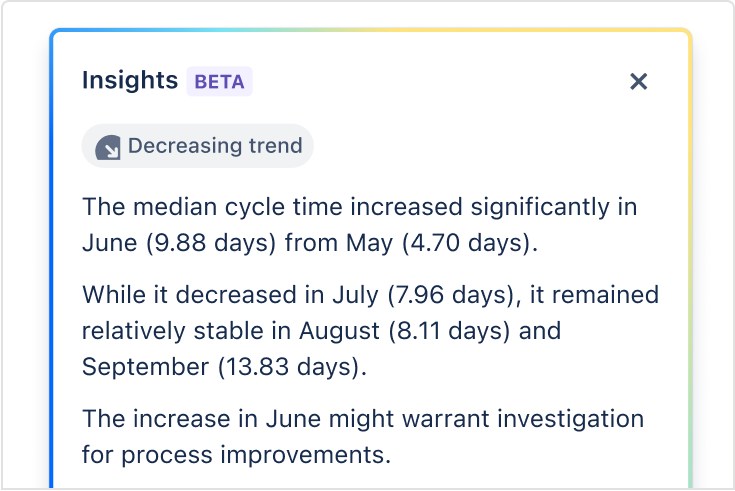
Two of the best use-cases for artificial intelligence are in search, where AI can turn natural language queries into Jira Query Language (or JQL), and in insight summaries based on data in the Atlassian Jira platform, such as the potential for process improvements.
The problem with marketing project management
As we have written about previously, we see 3 big problems with most marketing project management tools:
-
A focus on outputs over outcomes
-
Feature bloat
-
Jack of all trades, master of none
The outcomes over outputs trap remains the biggest challenge we see to effective marketing teams delivering real business outcomes and growth. Marketing team “work” quickly becomes focused on creating and assigning tasks, responding to notifications, joining team calls, communicating status updates and discussing what to work on next. Before you know it, high impact work gets replaced with work about work, and goals start shifting towards outputs as opposed to outcomes – because they’re easier to measure.
Growth has nothing to do with tactics, and everything to do with process. Growth is not about the terminology or the tactics, it’s about a change in our mentality, process, and team.
Brian Balfour, VP of Growth @ Hubspot (source)
The most popular comment on the ‘Do you use Jira with your marketing team?’ post in r/marketing on Reddit is as follows:
Jira is built for and works (pretty) well for software development teams. Marketers generally hate using it and it isn’t suited to the way most marketing organizations work
At Growth Method we believe a good marketing project management platform should be light on features. The goal should be to minimise (not maximise) the amount of time users spend in your app. The best marketing project management platforms get out of the way and enable team members to focus on execution.
Jira vs Growth Method for marketing teams
| Jira | Growth Method | |
|---|---|---|
| Built for | Software development teams, extended to business teams | B2B marketing teams specifically |
| Core unit of work | Issues, sprints, story points | Campaigns and experiments (hypothesis → plan → launch → analyse) |
| AI agents | Rovo agents, tuned for code review and sprint work | Agents that draft, plan, score, and launch marketing campaigns |
| Marketing integrations | Connects to Figma, Canva, Intercom via MCP | Native connections to GA4, PostHog, Google Ads, Search Console and more |
| Reporting focus | Burndown charts, velocity, time tracking | Campaign outcomes against your team’s growth goal |
| Learning loop | Manual retros | Built-in campaign analysis: what worked, and why |
Frequently asked questions
What is Jira for marketing teams?
Jira is a project management tool originally designed for software development but widely used by marketing teams to plan, execute, and track campaigns. It helps organise tasks, streamline workflows, and improve team collaboration, ensuring campaigns are delivered on time and within scope.
Is Jira good for marketing teams?
Jira can work for marketing teams that already run an engineering-style process with sprints and tickets, but many marketers find it heavier than they need. Its workflows, terminology, and AI agents are still built around software development, not campaign planning or growth experimentation.
How can marketing agencies use Jira for project management?
Marketing agencies can use Jira to manage client campaigns, track deliverables, and optimise team workflows. By using templates like marketing campaigns or content calendars, agencies can ensure consistency and efficiency. Features like timelines, task assignments, and reporting tools help agencies stay on top of deadlines and measure campaign success.
What are the benefits of using Jira for marketing projects?
-
Centralised Collaboration: Keeps all tasks and updates in one place.
-
Custom Workflows: Adapts to unique marketing processes.
-
Scalable Solution: Suitable for small teams or large organisations.
-
Enhanced Reporting: Tracks campaign performance and team productivity.
-
Integration Options: Connects with tools like Slack, Trello, and Google Drive.
What are some other marketing project management tools?
Other popular tools for managing marketing projects include:
-
Trello: A simple, visual Kanban tool for task tracking.
-
Asana: Ideal for managing campaigns with multiple collaborators.
-
Monday.com: A customisable platform for marketing workflows.
-
Wrike: Offers advanced features for resource and time management.
Each tool has its strengths, so teams should choose based on their specific needs and workflows.
About Growth Method
Jira’s problem for marketing teams was never a lack of features — it’s that its whole model of work, and now its AI agents, are built around sprints and tickets rather than campaigns and outcomes. Growth Method takes the opposite starting point: it’s the agentic marketing platform for B2B teams, built around a plan-launch-analyse workflow that people and agents use together, with agents that draft, prioritise, and launch campaigns based on your own connected data rather than generic project tickets.
If you’re evaluating Jira (or already fighting it) for your marketing team, get started to see how a purpose-built alternative compares with your own campaigns. If you decide to switch, the Growth Method team runs a free white-glove migration from Jira, so you won’t rebuild your backlog by hand.