
Table of contents
Of the rule-based models, time-decay is the one that maps most cleanly to how considered purchases actually build. It gives more credit to the touches closest to the sale and less to the earlier ones, on the logic that momentum compounds as a buyer nears a decision. That makes intuitive sense, especially for longer B2B cycles. The trade-off is that time-decay can quietly underrate the brand-building and discovery work that started the journey in the first place, simply because it happened a while ago. A sensible model, as long as you remember it favours the finish over the spark. For the wider picture, see our marketing attribution models.
Definition of time decay attribution
Time decay attribution is a model used by marketers to understand the effectiveness of their marketing channels. It’s a way of giving credit to the different touchpoints a customer interacts with before making a purchase. The closer a touchpoint is to the final sale, the more credit it gets. This means that the last ad a customer clicks on before buying gets the most credit, and the ones they clicked on earlier get less.
This model is based on the idea that the most recent interactions had the most impact on the customer’s decision to buy. It’s a useful tool for marketers because it helps them identify which of their marketing efforts are most effective at driving sales. This can help them make more informed decisions about where to invest their marketing budget.
An example of time decay attribution
Here is an example of how it works:
Growth Method, a SaaS company, launched a marketing campaign to attract new customers. The campaign included email marketing, social media ads, and search engine optimisation (SEO).
John, a potential customer, first discovered Growth Method through a social media ad. He clicked on the ad, browsed the website, but didn’t sign up. A week later, he received an email from Growth Method, reminding him of their services. He clicked on the email, revisited the website, but still didn’t sign up. Two weeks later, he searched for SaaS companies on Google, saw Growth Method in the search results, clicked on the link, and finally signed up for a trial.
In this scenario, the time decay attribution model would assign the most credit to the last touchpoint, which is the SEO. The email marketing would get less credit, and the social media ad would get the least credit, because it was the first touchpoint and happened the longest time ago. This model assumes that the touchpoints closer to the conversion are more important.
How does time decay attribution work?
Time decay attribution works by assigning more credit to the marketing touchpoints that are closer to the time of conversion or sale. This model operates on the assumption that the most recent interactions a customer has with a brand are the most influential in their decision to make a purchase. Therefore, the last ad or marketing effort a customer interacts with before buying gets the most credit, while earlier touchpoints receive less. This allows marketers to understand which strategies are most effective in driving conversions and adjust their efforts accordingly.
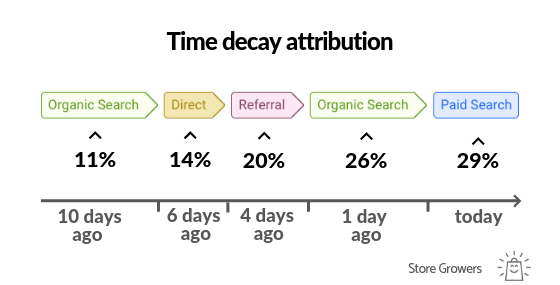
Time decay vs other attribution models
Time decay is one of several rule-based ways to distribute conversion credit across touchpoints. Here’s how it compares:
| Model | How it assigns credit | Best suited for |
|---|---|---|
| Time decay | More credit to touchpoints closer to conversion, less to earlier ones | Longer B2B cycles where momentum builds late |
| Last-click | 100% of the credit to the final touchpoint before conversion | Short, transactional funnels |
| Linear | Equal credit across every touchpoint | Teams wanting a simple, unbiased baseline |
| U-shaped (position-based) | 40% to first touch, 40% to last touch, 20% split across the middle | Businesses that value both discovery and conversion moments |
| Data-driven | Credit weighted algorithmically based on actual conversion patterns | Teams with enough volume and data to train a model |
Expert opinions and perspectives
Here are how some of the world’s best marketing and growth professionals, and companies, think about time decay attribution.
-
“Time-decay attribution is a multi-touch attribution model that gives some credit to all the channels that led to your customer converting, with that amount of credit being less (decaying) the further back in time the channel was interacted with.” - Dan Wakefield https://www.callrail.com/blog/what-is-time-decay-attribution
-
“In the Time Decay attribution model, the touchpoints closest in time to the sale or conversion get most of the credit” - Google https://support.google.com/analytics/answer/1662518

Questions to ask yourself
As a modern growth marketing or agile marketing professional, ask yourself the following questions with regard to time decay attribution:
-
Am I giving enough credit to the marketing touchpoints that occur closer to the conversion?
-
Does the time decay model accurately reflect the customer journey in my business?
-
Am I adjusting the time decay model to account for changes in customer behaviour over time?
-
Is the time decay model helping me to identify the most effective marketing channels for my business?
-
Am I using the insights from the time decay model to optimise my marketing strategy and drive growth?
Other articles you might like
Here are some related articles and further reading you may find helpful.
Additional reading
Here are some related articles and further reading around time decay attribution that you may find helpful.
-
“Understanding marketing attribution models” - Smart Insights
-
“Multi-Channel Attribution Modeling: The Good, Bad and Ugly Models” - Occam’s Razor by Avinash Kaushik
-
“What is Marketing Attribution? A Complete Guide” - Marketing Evolution
-
“The Definitive Guide to Attribution and Mix Modeling” - Neil Patel
-
“Time Decay Attribution Model in Google Analytics” - E-Nor Analytics Consulting
About Growth Method
Time decay attribution has the same blind spot as most reporting dashboards: it rewards whatever happened most recently and quietly discounts the work that built up to it. Growth Method takes the opposite view. It is the agentic marketing platform for B2B teams that plans, launches, and analyses campaigns from your live, first-party data, so every touchpoint, early or late, gets weighed on what it actually contributed rather than how recently it happened.
We are on-track to deliver a 43% increase in inbound leads this year. There is no doubt the adoption of Growth Method is the primary driver behind these results.
Laura Perrott, Colt Technology Services
Get started to turn your next attribution insight into a tracked campaign, not a one-off report.
Frequently asked questions
What is time decay attribution and when should I use it?
Time decay attribution is a rule-based model that gives progressively more credit to touchpoints the closer they are to conversion. It suits longer B2B sales cycles where a burst of activity right before the deal closes is a genuine sign of buying intent, but it is a weaker fit for short funnels or when you want to credit the channels that create initial awareness.
What is the formula for time decay attribution?
Most platforms use a half-life formula: each touchpoint’s credit halves for every fixed period, commonly seven days, further back from the conversion. A touchpoint on the day of conversion gets full weight, one from a week earlier gets half, one from two weeks earlier gets a quarter, and so on, with all weights normalised so total credit adds up to 100%.
Which statement is true about time decay attribution?
The statement most often tested is that time decay gives more credit to touchpoints that happen closer to the conversion, and less credit to those further away in time. It is a multi-touch model, meaning every touchpoint gets some credit, unlike single-touch models such as first-click or last-click that assign 100% of the credit to one interaction.
How is time decay attribution different from last-click attribution?
Last-click attribution gives 100% of the credit to the final touchpoint before conversion and ignores everything earlier. Time decay still favours recent touchpoints but spreads reduced credit across every earlier interaction too, so channels that contributed earlier in the journey are not written off completely.