
Table of contents
- What is a growth marketing specialist?
- What does a growth marketing specialist do?
- Growth marketing specialist responsibilities
- A day in the life of a growth marketing specialist
- Required skills for a growth marketing specialist
- Growth marketing specialist salary (2026)
- Growth marketing specialist career path
- Growth marketing specialist vs. similar roles
- What makes a great growth marketing specialist hire?
- Hiring a growth marketing specialist
A growth marketing specialist is a data-driven marketer focused on finding and exploiting the highest-leverage opportunities across the full customer lifecycle — from acquisition through to retention and referral. They are distinct from traditional marketing specialists in one key way: they treat every channel, message, and funnel stage as a hypothesis to be tested, not an assumption to be repeated.
This guide covers everything: what the role involves day-to-day, the skills and tools required, how the career ladder works, what growth marketing specialists earn in 2026, and how the role compares to similar positions.
Every modern business should have a growth marketing specialist because they use data-driven strategies to boost customer engagement, improve brand presence, and ultimately increase the company’s growth and profits.
Stuart Brameld, Growth Method CEO & Growth Advisor
What is a growth marketing specialist?
A growth marketing specialist is a practitioner-level role responsible for executing and iterating on growth programmes across one or more marketing channels. They sit below a growth marketing manager in the typical hierarchy, and they’re primarily focused on doing rather than directing — running experiments, analysing data, managing campaigns, and shipping improvements at pace.
The role exists because modern growth requires both strategic direction and disciplined execution. A specialist is the person who actually runs the A/B tests, builds the email sequences, optimises the paid campaigns, and reports on what’s working. They’re accountable for specific channels or funnel stages, and they own the numbers for those areas.
According to Google Trends, worldwide interest in growth marketing has grown substantially over the last 15 years and continues to rise. The LinkedIn 2023 Jobs on the Rise list placed growth and growth marketing-related roles consistently in the top 10 fastest-growing job titles worldwide, with 2 growth roles in the UK’s top 10.
What does a growth marketing specialist do?
A growth marketing specialist aims to attract more engaged customers and move them efficiently through the customer lifecycle. They work within the AARRR framework — Acquisition, Activation, Retention, Referral, Revenue — and typically own one or two stages of that funnel in depth.
They craft and execute a focused growth strategy, combining marketing, product, and data skills. Central to the role is experimentation — testing and iterating on tactics to find what drives the most measurable growth. They don’t work in isolation; they contribute to a culture of experimentation in which continuous testing and learning is the default operating mode.
Growth marketing specialist responsibilities
While the exact scope varies by company size and stage, a growth marketing specialist is typically responsible for:
- Executing growth experiments — designing, launching, and analysing A/B tests and other experiments within their assigned channels or funnel stages.
- Managing campaigns — running day-to-day paid, organic, email, or lifecycle campaigns and optimising performance against agreed KPIs.
- Data analysis and reporting — pulling and interpreting data from analytics platforms, building reports, and surfacing insights for the wider team.
- Conversion rate optimisation (CRO) — identifying friction points in the funnel and proposing and testing fixes.
- SEO and content execution — publishing and optimising content to drive organic traffic and improve rankings for target keywords.
- Lifecycle and retention campaigns — building and iterating on email, push, and in-app messaging sequences to activate and retain users.
- Experiment backlog management — contributing ideas to the growth backlog and scoring them using frameworks like ICE or PIE.
- Cross-functional collaboration — working with designers, developers, and product managers to ship growth-related changes.
- Competitor and market research — monitoring what competitors are doing across channels and identifying new opportunities.
- Maintaining dashboards — keeping growth metrics dashboards up to date so the team has a live view of performance.
A day in the life of a growth marketing specialist
No two days are identical, but a typical week might look like this:
- Monday: Review weekly metrics dashboard; flag any anomalies; brief the design team on creative assets for an upcoming landing page test.
- Tuesday: Pull data from the email platform to analyse the previous week’s nurture sequence performance; update the experiment log; write up learnings from a recently concluded A/B test.
- Wednesday: Publish two new blog posts optimised for target keywords; update internal links across related articles; submit updated sitemap to Search Console.
- Thursday: Run a paid acquisition campaign audit — pausing underperforming ad sets, increasing budget on winners; update CAC reporting.
- Friday: Weekly growth team sync — present results from the current sprint’s experiments; prioritise next week’s backlog; contribute ideas for the next test cycle.
Required skills for a growth marketing specialist
A strong growth marketing specialist is T-shaped: broad enough to understand the whole marketing mix, with deep expertise in one or two areas particularly relevant to the business.
The T-shaped marketer framework, popularised by Buffer, illustrates this well:
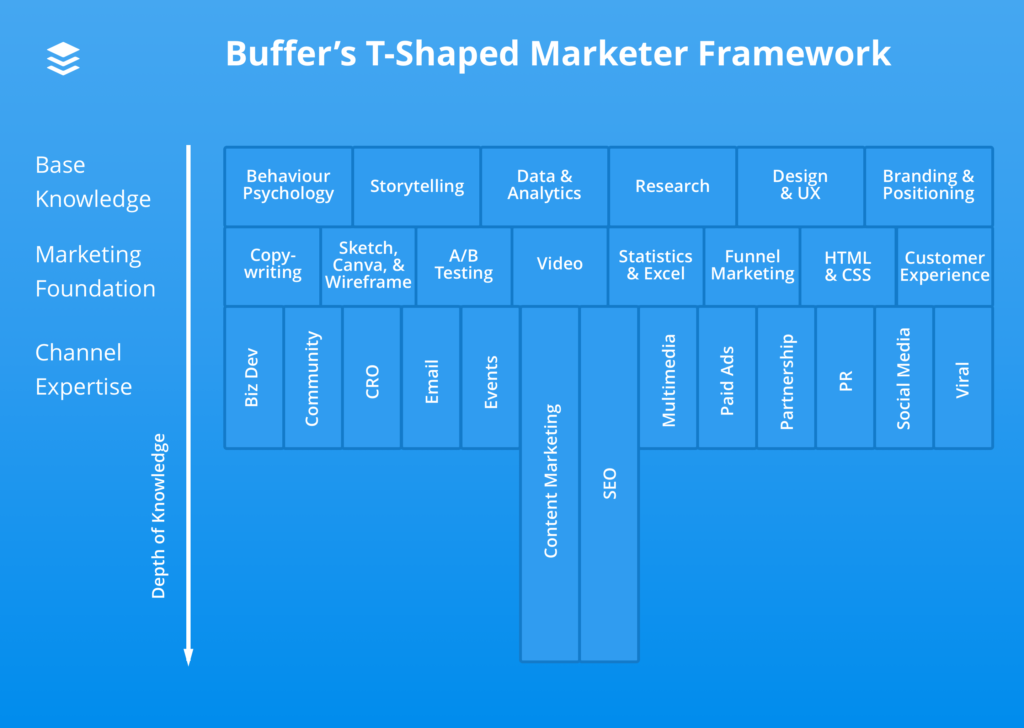
The vertical bar on the T represents the depth of related skills and expertise in a single field, whereas the horizontal bar is the ability to collaborate across disciplines with experts in other areas and to apply knowledge in areas of expertise other than one’s own.
Hard skills
| Skill | Importance | Common tools |
|---|---|---|
| Data analysis | High | PostHog, GA4, Looker, Amplitude |
| A/B testing & experimentation | High | Optimizely, VWO, PostHog Experiments |
| SEO & content | High | Search Console, Ahrefs, Semrush |
| Email & lifecycle marketing | Medium–High | HubSpot, Brevo, Customer.io |
| Paid acquisition | Medium–High | Google Ads, Meta Ads, LinkedIn Ads |
| CRO & UX analysis | Medium | Clarity, Hotjar |
| Marketing automation | Medium | Zapier, n8n, HubSpot |
Soft skills
Daphne Tideman highlights four essential traits to look for in your first growth hire: a balance of strategic and tactical thinking, openness to feedback, intellectual curiosity, and applied intelligence.
Beyond those, the most effective growth marketing specialists tend to share these characteristics:
- Analytical — they base decisions on evidence, not gut feeling, and are comfortable pulling and interpreting data themselves.
- Creative — they can generate novel ideas for tests, campaigns, and messaging, and aren’t limited by what’s been done before.
- Obsessed with metrics — they track KPIs closely and know instinctively when a number looks off.
- Adaptable — they adjust quickly when a channel or tactic stops working, without needing to be told.
- Tech-savvy — they’re comfortable learning new tools and stay on top of platform changes and emerging channels.
- Strong communicator — they translate data into clear findings and can get buy-in for new experiments from non-technical colleagues.
Growth marketing specialist salary (2026)
Salaries for growth marketing specialists vary significantly by location, company stage, and level of experience. Here are the current benchmarks as of 2026:
United States
| Experience level | Annual salary |
|---|---|
| Entry-level (0–2 years) | $50,000–$65,000 |
| Mid-level (2–4 years) | $65,000–$85,000 |
| Senior specialist (4–6 years) | $85,000–$110,000 |
Source: ZipRecruiter (March 2026) reports a US average of approximately $61,000, with a range of $47,500–$82,500 across all experience levels. High-cost cities such as San Francisco, New York, and Seattle pay materially above the national average.
United Kingdom
| Experience level | Annual salary |
|---|---|
| Entry-level (0–2 years) | £28,000–£38,000 |
| Mid-level (2–4 years) | £38,000–£50,000 |
| Senior specialist (4–6 years) | £50,000–£65,000 |
London-based roles typically pay 15–25% above the UK national average.
Note: At well-funded start-ups and scale-ups, total compensation (base + equity + bonus) can significantly exceed these figures. Equity in particular can be material at Series A–C companies.
For active job listings, see growth marketing specialist roles on LinkedIn or our roundup of the top job boards for growth roles.
Growth marketing specialist career path
The growth marketing career ladder typically looks like this:
| Level | Title | Typical experience | Focus |
|---|---|---|---|
| Entry | Junior Growth Marketer / Growth Marketing Specialist | 0–2 years | Channel execution, campaign management, experiment support |
| Specialist | Growth Marketing Specialist | 2–4 years | Owning specific channels or funnel stages, running experiments independently |
| Manager | Growth Marketing Manager | 3–6 years | Programme ownership, experimentation strategy, cross-functional work |
| Senior | Senior Growth Marketing Manager | 5–9 years | Multi-channel strategy, team leadership, owning a growth lever end-to-end |
| Director | Growth Director | 7–12 years | Multi-channel strategy, team management, board reporting |
| VP/Head | Head of Growth | 9+ years | Company-level growth strategy, P&L ownership |
How to become a growth marketing specialist
There is no single required qualification. Most growth marketing specialists arrive through one of a few routes:
- Via a generalist marketing role — spending 1–2 years in a broader marketing coordinator or digital marketing role before specialising in growth.
- Via a channel specialism — starting in paid search, SEO, or email marketing and broadening into full-funnel growth work.
- Via a growth marketing course — a number of structured programmes now exist that teach the core disciplines (experimentation, analytics, funnel strategy) in a compressed format.
- Via product or analytics roles — particularly for those joining from tech or data backgrounds who want to move into marketing.
Regardless of route, the fastest way to progress is to build a track record of experiments run and results achieved. Employers hiring for growth roles are almost universally focused on outcomes over credentials.
Growth marketing specialist vs. similar roles
| Role | Key difference |
|---|---|
| Growth Marketing Specialist | Practitioner-level; executes within specific channels or funnel stages. Typically 0–4 years’ experience. |
| Growth Marketing Manager | More senior; owns the full growth programme, manages experiments across all channels, often manages people. |
| Growth Hacker | Often interchangeable, but “growth hacker” implies a more scrappy, startup-focused approach with heavier technical/product overlap. |
| Digital Growth Manager | Similar scope but often more focused on digital/performance channels; less emphasis on full-funnel experimentation. |
| Head of Growth | Senior leadership role; sets growth strategy, owns the team and the P&L. |
| Growth Director | Director-level; multi-channel strategy, team management, executive stakeholder management. |
The most important distinction is between a specialist and a manager: a specialist executes and iterates within a defined scope; a manager owns the programme, sets priorities, and is accountable for growth outcomes across the whole funnel. A specialist typically progresses to a manager role after 2–4 years, once they have demonstrated the ability to run experiments independently and influence strategy.
What makes a great growth marketing specialist hire?
Beyond the skills listed above, the best growth marketing specialists share a few defining characteristics:
- They default to testing. Rather than debating which approach is best, they design a minimum viable experiment to find out.
- They think in systems. They’re always asking how a tactic compounds over time, not just what it delivers this week.
- They build leverage. They look for growth loops — self-reinforcing mechanisms — rather than one-off campaigns.
- They own their numbers. They know their KPIs cold and don’t need to be chased for reporting.
If you’re building a growth team, our article on growth team structure covers the models that work at different company stages. For a broader perspective on what marketing leaders are prioritising right now, our roundup of CMO Survey reports from Gartner, Forrester, and PwC is worth reading.
Hiring a growth marketing specialist
Looking to hire a growth marketing specialist? Our guide to the top job boards for growth and growth marketing roles covers the best places to post and search. To write the posting itself, use our growth marketing job description template, which includes a ready-to-use specialist version.
The growth marketing specialist role is being reshaped by exactly this shift. AI is collapsing narrow specialisms into broader ones, and the marketers who win are the T-shaped generalists who can run the whole loop themselves: idea, campaign, measurement, iterate. A small team working this way drives more impact than teams many times their size.
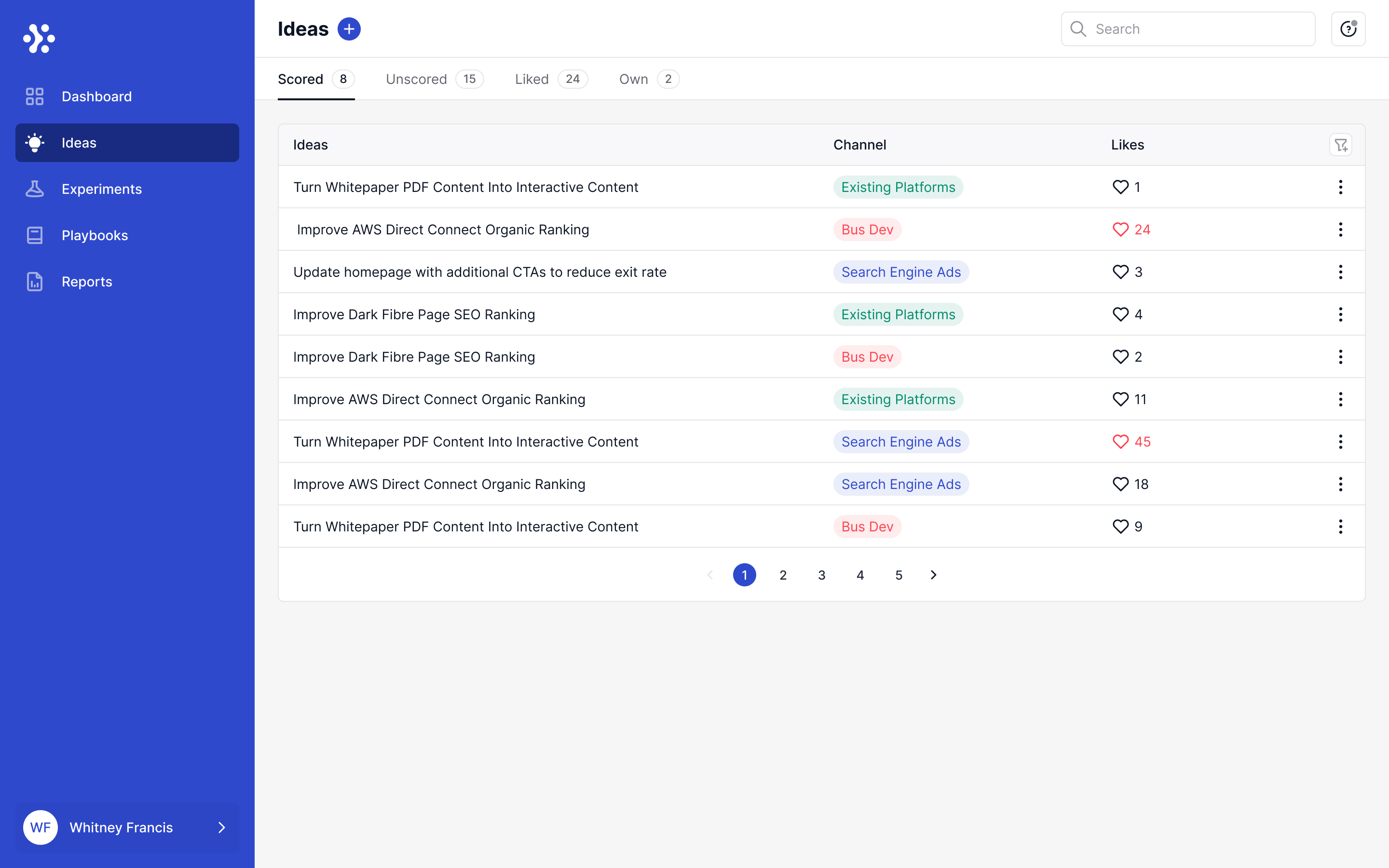
That’s the bet behind Growth Method: an agentic marketing platform that lets a small team, or even a single generalist, generate campaign ideas from real data, launch them, and prove what worked.
Get started, or connect with Stuart on LinkedIn.