
Table of contents
- Introduction
- A Brief History of Marketing Agencies
- Common Problems With Marketing Agencies
- Why the Agency Model Is Breaking
- When Hiring an Agency Makes Sense
- Questions to Ask Before Hiring a Marketing Agency
- Alternatives to Hiring a Marketing Agency
- Benefits of an In-House Growth Team
- About Growth Method
- Frequently asked questions
Introduction
Marketing agencies have evolved significantly over the past few decades. While traditional advertising relied heavily on billboards, print ads, and TV commercials, today’s agencies focus primarily on digital channels. However, despite this shift, many agencies still operate with outdated mindsets and practices. Buzzwords like AI, machine learning, and big data are frequently used, making it difficult to distinguish genuinely effective agencies from those simply skilled at pitching.
A Brief History of Marketing Agencies
The advertising agency has a surprisingly long history. William Taylor established the first recognised advertising agency in London back in 1786. In the United States, Volney B. Palmer opened the first American agency in Philadelphia in 1840, primarily working as a space broker—buying newspaper space at a discount and reselling it to advertisers at a markup.
The industry transformed when N.W. Ayer & Son emerged in New York, shifting from simply selling ad space to offering comprehensive services including planning, creating, and executing complete campaigns. This full-service model became the template for modern agencies.
The 20th century saw rapid globalisation. McCann Erickson (founded 1902) expanded into Europe by 1927 and later into South America and Australia. J. Walter Thompson followed a similar path, while Saatchi & Saatchi (established 1970) rose to prominence through landmark clients like British Airways and Toyota.
The internet era fundamentally disrupted this model. The emergence of advertising technology (AdTech) enabled brands to bypass traditional agencies entirely, running campaigns directly through platforms like Google and Facebook. Today’s agencies compete by developing custom AdTech solutions and leveraging customer data analytics—though many still operate with the same mindset as their space-broker predecessors from nearly two centuries ago.
For a deeper dive into agency history, see The History of Advertising Agency from Avenga.
In this article, we’ll explore the good, the bad, and the ugly of marketing agencies. You’ll learn how to spot red flags, when hiring an agency makes sense, and what alternatives exist to help you achieve your growth marketing goals.
Common Problems With Marketing Agencies
Misaligned Goals
One of the biggest issues when working with marketing agencies is misaligned goals. Many agencies measure success by how much of your budget they spend, rather than by meaningful business outcomes such as:
-
Increasing revenue
-
Acquiring new customers
-
Improving conversion rates
-
Generating qualified leads (MQLs and SQLs)
Agencies often lack accountability for your business objectives, treating your account as just another client rather than a partner whose success matters.
Junior Staff Doing the Work
Agencies frequently pitch their services using senior executives, but the actual work is often delegated to junior team members with limited experience. This practice can lead to subpar results and frustration for your business.
Cookie-Cutter Strategies
Many agencies apply standardised strategies across all clients, regardless of unique business needs or market conditions. Effective growth marketing requires tailored approaches, not generic solutions. If an agency isn’t willing to deeply understand your business and customise their strategy, it’s a clear warning sign.
Long “Testing” Periods
Some agencies ask clients to accept poor results for the first few months, labelling this as a “testing period”. This is unacceptable. Effective growth marketers deliver meaningful insights and measurable results from day one.
Claiming Expertise in Everything
Be cautious of agencies claiming expertise across all marketing disciplines. Growth marketing requires specialised knowledge. Agencies that claim to do everything often lack the depth needed to deliver meaningful results. Instead, look for agencies or consultants with clear specialisation and proven track records in specific areas relevant to your business.
Lack of a Holistic Approach
Effective growth marketing involves optimising the entire customer journey, not just running ads. Agencies that focus solely on ad spend often neglect critical areas such as:
-
Landing page optimisation
-
Product messaging and positioning
-
Pricing strategies
-
Customer incentives and urgency mechanics
A good growth marketer or agency takes ownership of the entire customer experience, ensuring every touchpoint is optimised to drive conversions and revenue.
Insufficient User Research
Continuous user research is essential for effective growth marketing. Agencies that don’t prioritise user research are essentially guessing. Choose partners who regularly conduct research to inform their strategies, ensuring decisions are data-driven and customer-centric.
Why the Agency Model Is Breaking
The traditional agency model faces an existential challenge. AI tools have fundamentally changed the economics of marketing execution. Tasks that previously required extensive human effort—competitive analysis, content repurposing, reporting—now take a fraction of the time. Work that once required ten people can now be done by three with the right systems.
This shift exposes a critical weakness: agencies built on headcount no longer have a defensible advantage. In-house teams now have access to the same tools and can build their own workflows. The question every business should ask is: what can this agency do that we can’t replicate ourselves?
The old model of outsourcing execution while keeping strategy in-house no longer works either. Marketing environments move faster than annual planning cycles. By the time an agency implements a strategy developed months ago, the landscape has already shifted.
Agencies that survive will need to offer genuine strategic involvement—not just execution. This means senior strategists working directly with clients, flexible engagement models that adapt to actual business needs, and a clear understanding of where AI acceleration adds value versus where human judgement matters most.
For more on this shift, see The Marketing Agency Model is Broken from Ten Speed.
When Hiring an Agency Makes Sense
Despite these common pitfalls, there are scenarios where hiring an agency can be beneficial:
-
You have a proven acquisition formula (landing pages, ad copy, targeting) and simply need someone to scale it efficiently.
-
You temporarily lost an in-house expert and need a short-term solution.
-
Your primary goal is straightforward paid media management, and you have clear, measurable KPIs.
However, keep in mind that acquisition strategies typically have a limited lifespan. Landing pages and ad creatives need regular refreshing, and agencies often struggle to iterate quickly enough to sustain long-term success.
Questions to Ask Before Hiring a Marketing Agency
Before signing a contract, ask these critical questions to evaluate an agency’s true capabilities:
-
What meaningful results have you driven for similar products or services?
-
What was the specific cost of acquisition (CAC) for comparable products?
-
What conversion rates have you achieved on prospecting traffic?
-
How did CAC evolve over time on channels like Facebook and Google?
If an agency can’t confidently answer these questions or hesitates to share relevant data, consider it a significant red flag.
Alternatives to Hiring a Marketing Agency
If you’re wary of agencies, consider these alternatives:
-
Hire in-house: Bring on a senior growth marketer or pair a junior marketer with an experienced mentor. This builds institutional knowledge and ensures alignment with your business goals.
-
Engage a freelance growth expert: Many talented growth consultants offer flexible, part-time engagements. They can deliver significant value in fewer hours per week than a full-time hire or agency, with the added benefit of month-to-month flexibility.
-
Start fractional: Daphne Tideman recommends that early-stage companies uncertain about their needs consider fractional growth roles before committing to a full-time hire or agency. Once you’ve identified which channels work, a full-time commitment makes more sense.
Marketing agency vs in-house team vs fractional/freelance vs Growth Method
If you’re weighing a full-service agency against hiring an individual instead, it’s worth comparing the options directly — see our guides to growth marketing consultants and growth hacking agencies for a closer look at those specific options. Here’s how the broad categories stack up:
| Marketing agency | In-house team | Fractional / freelance | Growth Method | |
|---|---|---|---|---|
| Focus | Full-service execution across channels | Whatever the role is scoped to cover | A specific channel or problem | The system that runs underneath any of the above |
| Typical cost | Retainer, project fee, or % of ad spend | £45k-£80k+/year salary per hire | £400-£900/day or a monthly retainer | $150/user/month |
| Speed to impact | Medium — onboarding and ramp-up first | Slow — hiring and ramp-up time | Fast — brought in to fix a specific problem | Immediate — plugs into your existing stack |
| Control | Lower — external, shared priorities | Highest — full-time, dedicated | Lower — external, part-time | Highest — your team, your data, your calls |
| Best for | Scaling a proven acquisition formula | Long-term, ongoing growth ownership | Diagnosing or fixing a specific bottleneck | Any team that wants agency-or-in-house rigour without the overhead |
Benefits of an In-House Growth Team
An in-house growth marketing team offers several advantages:
-
Deep understanding of your product, customers, and market
-
Ability to move quickly and adapt to changes
-
Accumulation of institutional knowledge and learnings
-
Direct accountability and alignment with your business goals
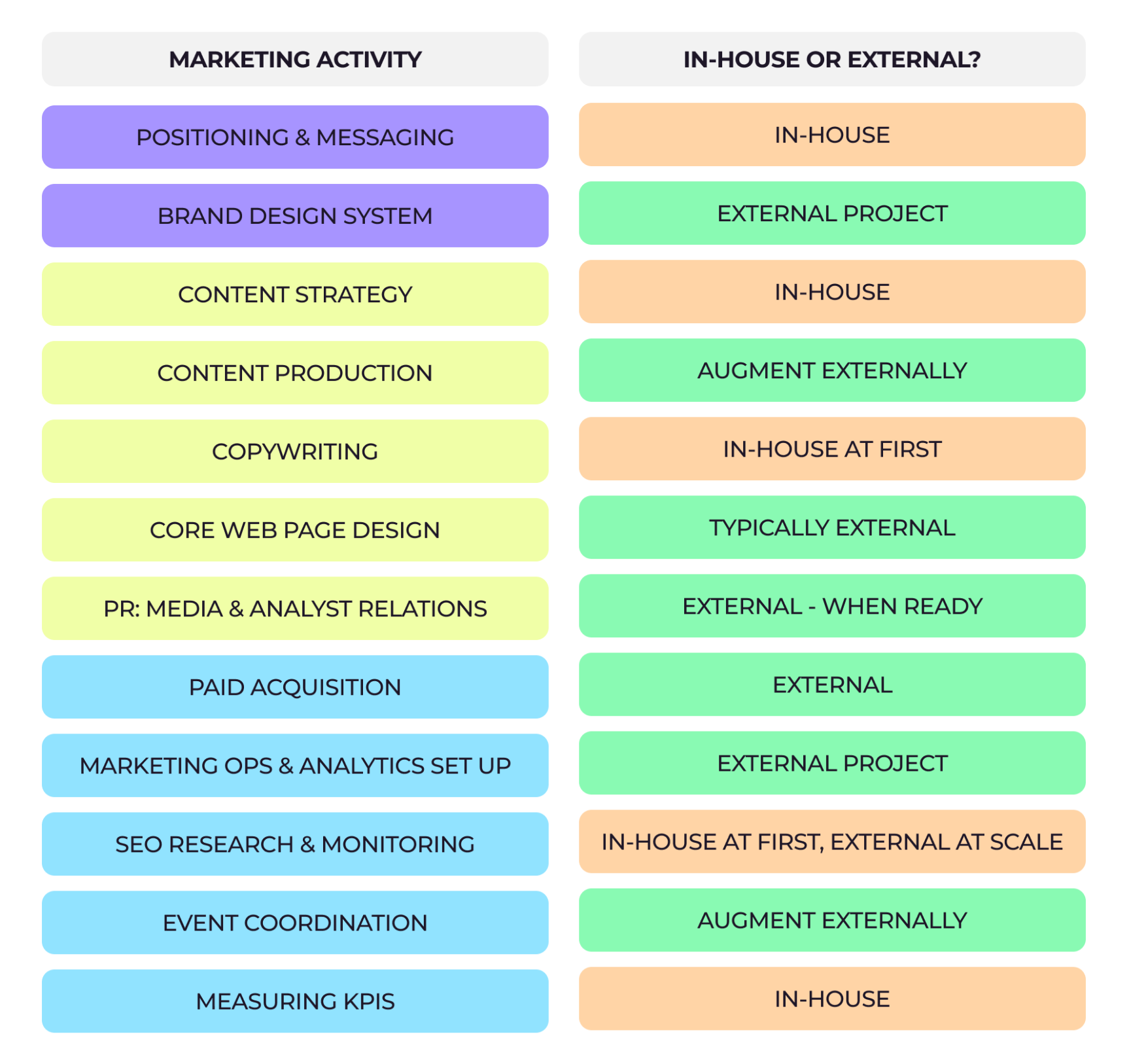
For a helpful visual guide on which marketing activities are best handled in-house versus externally, check out this graphic from MKT1.
About Growth Method
Whichever way you go — agency, freelancer, or in-house team — what actually decides whether marketing works is whether someone owns a clear goal, runs a disciplined test-and-learn process, and learns from live marketing data instead of vanity reports. That’s the gap Growth Method is built to close: an agentic marketing platform for B2B teams that plans strategy, ships campaigns, and tells you what worked and why, using data from your own connected stack (GA4, PostHog, Google Search Console, Google Ads and more).
For teams weighing up an in-house build instead of renewing an agency retainer, Growth Method gives a lean team of generalists the same planning, prioritisation and reporting muscle a full agency would bring, minus the shared priorities and the monthly invoice.
As Laura Perrott from Colt Technology Services says:
We are on-track to deliver a 43% increase in inbound leads this year. There is no doubt the adoption of Growth Method is the primary driver behind these results.
Get started: your first month is free.
Frequently asked questions
What does a marketing agency do?
A marketing agency plans, creates and runs marketing activity on a client’s behalf, typically covering channels like paid media, SEO, content and creative, in exchange for a retainer, project fee or percentage of ad spend.
What is the business model of a marketing agency?
Most marketing agencies bill on a retainer, project fee, or a percentage of the ad spend they manage. Some also mark up media buying or take a commission on top of agency fees, which is why it pays to ask exactly how they’re compensated before you sign.
What are common challenges with marketing agencies?
The most common challenges are misaligned incentives (being paid on spend rather than results), junior staff doing the actual work, cookie-cutter strategies applied across every client, and a lack of accountability for the business outcomes that actually matter.